Tuesday, March 26, 2024

The Theory of the Leisure Class by Thorstein Veblen

I was unaware of Veblen’s ideas until a recent edition of In Our Time on BBC Radio 4 devoted an hour of discussion to his life and work. So stimulating did I find the discussion that I immediately found a copy of The Theory of the Leisure Class and read it. 

Thorstein Veblen’s ideas crystallised in the last quarter of the nineteenth century when the infamous “robber barons” of emergent American capitalism were at the height of their power and ownership. Not only did they form a social class, but these multi-millionaires also created social norms that many desired to emulate. A measure of success in the popular mind became how closely an individual might aspire to emulate their lives of great riches and, at least when viewed from the outside, great leisure. Conspicuous consumption, following their example, became an economic goal and a measure of success. Veblen related this tendency of upper social classes to remnants of “barbarianism”, stemming from “tribal” societies. Everything was related to ownership resulting from conquest and warfare, in which the defeated were enslaved so that the victors could benefit from the fruits of their labour. On page two, Veblen identifies broad occupations and activities in contemporary society that derive from this ancient tendency. “These non-industrial upper-class occupations may be roughly comprised under government, warfare, religious observances and sports.” The label “non-industrial” differentiated these people from the vast majority of the population, who laboured cooperatively for the common good by producing things that increased human capabilities and well-being.

There thus develops in Veblen’s work a theory of economic production and distribution that is derived from psychological traits and has sociological implications. He extends his ideas about non-cooperative barbarism and “predatory” tendencies to illustrate how making oneself useless can become a sign of ultimate power and success. Though the social class that is guilty of this flagrant over-consumption of goods and services is demonstrated as being anti-social, as far as the interests of the industrial classes are concerned, Veblen never alludes to any possible conflict that might arise. This is what differentiates his ideas from those of Marx.

The psychological and behavioural aspects are explored, alongside and their consequences for economic and social class differences. He develops a theory of “manners” that allow members of the upper classes to identify themselves to one another. “There are few things that so touch us with instinctive revulsion as a breach of decorum; and so far have we progressed in the direction of imputing intrinsic utility to the ceremonial observances of etiquette that few of us, if any, can dissociate an offence against etiquette from a sense of the substantial unworthiness of the offender. A breach of faith may be condoned, but a breach of decorum can not. “Manners maketh the man”.” Again, he is not doing any of this in order to poke fun or satirise individuals. He does, however, make it clear that the existence of the upper classes does work against the interests of the industrial classes, who are labouring to make everyone’s life better.

The industrial classes, though privately desiring to emulate their social betters, however, at least try to maintain their own values. “The popular reprobation of waste goes to say that in order to be at peace with himself the common man must be able to see in any and all human effort and human enjoyment an enhancement of life and well-being on the whole … Relative or competitive advantage of one individual or comparison with another does not satisfy the economic conscience and the form of competitive expenditure has not the approval of his conscience.” 

Conspicuous consumption amongst the ownership classes drives them to value political ideas, laws and social practices that allow them to maintain their lifestyle. This inevitably results in political and social conservatism. “This conservatism of the wealthy class is so obvious a feature that it has even become recognised as a mark of respectability.” Privately, the industrial classes still aspire to the conspicuous consumption and leisure of the wealthy and so have a tendency to espouse their conservatism in the hope that one day they might achieve similar status.

All forms of religious establishment, military rank, political and even sporting success are manifestations of this over-consumption to the detriment of the industrial class, throwbacks to the barbarism and predatory nature of a society based on conflict. But here I find a weakness in Veblen’s argument. He does not see capitalist consumerism’s pursuit of individualism as necessarily fostering the creation of the leisure class. Furthermore, he assumes that pre-industrial, pre-scientific, societies are all based upon predation, but offers scant evidence to illustrate this.  

As a fan of “classical” music, I was intrigued by a passage that defined the term. ““Classic” always carries this connotation of wasteful and archaic, whether it is used to denote the dead languages or the obsolete or obsolescent forms of thought and diction in the living language, or to denote other items of scholarly activity or apparatus to which it is applied with aptness.” Capitalism cannot sell “classical” music. Calling it thus, even when the label only applies to about sixty years in the thousand-year history of European-style music is thus clearly a way of marginalising it.

Veblen’s ideas are now in sharp focus because of environmental degradation. The role of “consumption as status” needs to be uppermost in everyone’s mind. The less consumption, the less pressure is placed on the environment. The consequence of lower consumption would probably be the collapse of capitalism and it is this aspect, this consequence of his theories that is sadly rather lacking from Veblen’s work.

Sunday, March 24, 2024

The Stavanger Symphony Orchestra with Andris Poga and Behzod Abduraimov in Matre, Prokofiev and Tchaikovsky

Orchestras on tour often take some of their home repertoire with them. In the case of the Stavanger Symphony Orchestra under the direction of Andris Poga in Alicante last night, this took the form on the published program of a contemporary interpretation of some famous nineteenth century pieces. The Norwegian composer Ørjan Matre has reworked some of Edvard Grieg’s Lyric Pieces for orchestra. I hesitate to say simply “orchestrated”, because the contemporary composer’s contribution is specific and significantly more than transcription. It’s tantamount to reinterpretation.

Alicante’s ADDA audience heard four of the pieces, beginning with the Arietta from book one. Almost as if to remind the audience of the piece’s origin, the composer starts with solo piano, and the orchestra almost apologizes for its presence as the piece proceeds. The textures and combinations employed are designed to communicate the context of the inspiration. The titles of the pieces, Arietta, Spring dance, Solitary traveller, and Butterfly give clues as to what Grieg might have been thinking and Matre creates beautiful illustrations by his wholly original and refreshingly light use of orchestral sound.

After the interval, the Stavanger Symphony Orchestra gave a performance of Tchaikovsky’s Fifth Symphony. Now this a work the Alicante audience knows well, so it was with interest and anticipation that it was received. We were not disappointed. This was a strong, forceful reading of the score. The triumphalism of the finale certainly asserted itself, but this happened perhaps at the cost of a detail or two in the preceding narrative that became lost in the force of the orchestral sound. Such matters are a conductor’s choice and clearly Andris Poga wanted to stress the growth to confidence above the experience of insecurities that led up to the endpoint.

Set between the reinterpreted Grieg and Tchaikovsky’s triumphal finale was a real gem. Its not often that a pianist takes on the Second Piano Concerto of Prokofiev, but here Behzod Abduraimov did just that. And what a perfectly splendid job he made of it.

The start was slower than expected, with Prokofiev’s opening theme, meandering even when faster, almost breaking apart. But then the slower tempo allowed the music’s vast array of colours to shine through. By the time, Behzod Abduraimov had reached the massive first movement credenza, the complexity on the ear had become strangely simplified, and the pyrotechnics of the piano part seemed almost inevitable, merely a given in the overall argument. The essential shape of the music was thus preserved, and the audience was treated to truly communicative playing, and not mere virtuosity.

There are times when this music from 1913 sounds almost industrial. I am sure this was Prokofiev’s intention. The work, after all, was revised ten years later, so it is hard in the concert hall to imagine what the composer might have changed. Suffice to say that the joins do not show.

Behzod Abduraimov was magnificent. His playing was strong where it needed to be, occasionally explosive and often lyrical at the same time. His faultless solo part was accompanied by wonderful orchestral playing that really brought out every nuance of detail in the score. This is abstract music, but there are many passages that seem to refer to popular forms, albeit seen in a distorting mirror. And if you think even the opening theme might be simple, just try singing it to yourself. Good luck. It’s a perfect example of Prokofiev’s lyrical genius, where he concocted a singularly beautiful tune that sticks in the memory, but an idea that remains elusive and almost impossible to reproduce.

But at the end of the evening the orchestra returned home. As an encore, we had two of Grieg’s Lyric Pieces in orchestral versions. The Wedding Day At Troldhaugen for string orchestra was particularly successful.

Saturday, March 16, 2024

St John Passion in ADDA Alicante with Ruben Jais and Coro Labarocco de Milano

It is at least forty years since I heard a concert performance of a Bach Passion. It is probably a decade since I heard a complete performance. I am not a believer in Christian myth. I cannot participate in a performance of such a work as the composer anticipated that its intended audience might. For me, it’s a story, some of which might actually have happened. That makes a performance of the work very similar to anything else based on the text of a story, such as an opera, oratorio or song. So my appreciation of the work is solely from the perspective of someone interested in music.

But Bach’s Passions were not works assembled as a singular artwork. The purpose was clear: to tell a story, but also to provoke religious sentiment. This second objective is not possible for me, but then I do know enough about the events to realise what the intention might have been.

The music is necessarily episodic. Three different forms predominate. These are, of course, choral sections, where the singers are largely cast in the role of the voices of the people. Then there are the dramatis personae who have solo roles, some of which are expanded into arias, which, frankly, are present purely for the musical, not dramatic effect. And then, listed last but certainly not least, there is the role of the evangelist, the storyteller. The part, usually sung by a tenor voice, without vibrato or affectation, so that every word can be heard, is crucial. Without it, there would be no story. And, in this performance, in Alicante’s ADDA auditorium, the amazing performance of Bernard Berchtold in the role brought the evening literally to life.

There was a slight flaw in the staging, however. The solo arias were delivered by members of the chorus. Though they did have a featured platform from which to project, this was set at the back of the orchestra, immediately in front of the rest of the chorus. I understand the logistical difficulties of bringing the solo voice to the front of the stage, but equally placing it behind the orchestra perhaps diminishes the voice’s presence in the hall. It was clearly audible, but for me these sections, which should stand out, did not. In the second part, we heard the two violins accompanying an aria at the front of the stage, whilst the voice was almost at the back.

Structurally, the music now seems more modern than I remember. JS Bach’s practice of pitting solo voices against selected instrumental sonorities seems to be very contemporary. There were the violins, of course, but a particularly successful passage has a bassoon predominant and oboes, flutes and cors anglais play significant roles.

But I have to reserve the real praise for Bernard Berchtold’s performance as the evangelist. The voice was perfectly suited to the role. The delivery was interpretive and conveyed both meaning and nuance. The crystal clarity of the sound was always interesting to listen to, and the voice did not tire, as many often do, in this long and exacting role. I am sure that Bernard Berchtold has sung this role before, and I am equally sure that he will be offered many more opportunities to do so.

Coro Labarocca di Milano gave a controlled but committed performance throughout. Johannes Held’s Jesus was convincing and the ADDA orchestra offered their usual perfection. Ruben Jais was also perfection, in a quiet way.

Friday, March 1, 2024

The Desconstruction of Mahler: ADDA under Josep Vicent with Patrick Messina in Adams, Brahms and Berio


This was a very special concert. It will live in the memory for as long as breath continues. It was nothing less than a triumph of artistic direction on behalf of Josep Vicent. All three featured works were, in their own way, quite recent, given the often-backward-looking character of concert programmes.

The evening began with a short, modern masterpiece. The program notes suggested that in our era, true myth (an oxymoron if ever there was one) is found not in characters of ancient Greek epics, but in the celebrities that populate our minds during waking hours. John Adams’s opera, Nixon in China, characteristically set recent events to music on a stage. Part of the opera’s point is that those figures involved in making history also have lives to live. John Adams cast Chairman Mao and his wife as dancers and the music to accompany this is The Chairman Dances, a Foxtrot for Orchestra.

It begins with a minimalist-sounding incessant rhythm, but in a moment of true magic, transforms itself into an almost sentimental dance, as if the celebrities forget themselves for a short time, and suddenly become human. Order does reassert itself as responsibilities and public faces re-emerge. The orchestral sound of this piece is vivid and multi-layered, but it does remind us continually that the clock rules rhythm, and perhaps our lives. It certainly rules the dance.

Second on the ADDA programme was Brahms’s Clarinet Sonata Opus 120. But this version was orchestral, the arrangement provided by Luciano Berio in 1986. Berio did not change Brahms’s original concept, but filled it out, so it occupied bigger space, even suggesting the concerto form. He was faithful to Brahms’s intention and this intimate, highly personal and lyrical work is now capable of filling a concert hall, though gently and in its original character. Patrick Messina as soloist gave a perfect (there is no other word) performance, totally controlled, completely in sympathy with the music. It was a performance with a humility that brought out the intentional understatement of the work. As an encore, we were treated to a more classical use of the clarinet with string accompaniment, again an arrangement.

The second half was given to a single work, a performance of Luciano Berrio’s Sinfonia for orchestra and amplified voices. The voices in question were London Voices, who seemed wholly at home with the highly multidimensional and unusual format of the piece.

Berio’s concept seems to grow spontaneously out of the experience of a twentieth century city. Charles Ives had at the start of the century chose impressionistic experience to portray the complexity of modern life. In his Sinfonia, Luciano Berio offered similar experience, but one on speed by comparison with that of Ives. An apparent jumble of sights, sounds, intellectual stimuli, musical references, passing comments and literary memories appear and combine to create a vivid, surreal collage, which deliberately does not hang together. It doesn’t because modern life is itself multidimensional, confused, confusing, stimulating, threatening and tender all at the same time. If I have one minor criticism, it is that the spoken text of the voices was not sufficiently prominent. Whether this matters is a matter of opinion. When visual art, for instance, features a raft of text, surely its effect is lost when viewers have to both read it and translate it. It may be the same with the words that Berio featured in this work. The word Majaskowsky did, however, hang in clean air. The text, by the way, is as collage-like as the music. It’s not a narrative, and is influenced by, amongst others, James Joyce and Samuel Beckett. Absurdity rules. This was thoroughly memorable music, and it was stunningly performed by the singers and musicians alike. 
In this performance, Josep Vicent chose to play this work in its original four movements. Berio did add a fifth, but I think the logic might have been to create space for the encores, which in their way added to the collage-like experience. Berio quotes extensively from Mahler in his Sinfonia. As an encore, this led to a performance of the Adagietto from the fifth symphony. After the apparent anarchy of the Berio, the long lines made a peaceful and beautiful contrast. Then, when we all thought the pastiche could not get richer, London Voices, with the accompaniment of a brushed drum, gave a fugue in a cappella jazz style with an upbeat rhythm. Lets not try to explain. Let’s just listen.

Sunday, February 4, 2024

Manuel de Falla's La Vida Breve in Alicante with Sandra Fernandez and Miguel Ortega

La Vida Breve by Manuel de Falla is a problematic work. Its problem stems mainly from the fact that it is an opera that lasts just over an hour. Productions of it generally have to be combined with another short work. Now there is no shortage of one act operas, but there is a shortage of companies willing to juxtapose two works of inevitably different styles on one programme. Opera North in Leeds did it in 2015, staging it alongside Gianni Schicchi of Puccini in a tragic-to-ridiculous pairing. It worked, but not every opera company is as keen to take risks as Opera North. Bluebeard’s Castle is an obvious pairing, but the emotional territory is perhaps too similar to that of La Vida Breve. Just how many women does an audience want to kill off in one evening? And so it is via concert performances that audiences are most likely to experience Manuel de Falla’s early opera, and so it was in ADDA, Alicante last night, under the direction of Manuel Ortega.

Opera in the concert hall bring the music to front stage. Yes, the singers are there, and they have to perform, but usually there is little action. It has to be admitted that even in a full staging of La Vida Breve it might be hard to find much action. A femme fatale is in love with a man above her social class. She laments the fact that lonely birds die, that lone flowers wither. A chorus extols the virtue of working for a living, stressing the identity that shared tasks can promote. But they do repeat the fact that it is better to be born the hammer rather than the anvil, a none-too-subtle reference to the difference in social class between the two lovers, Salud and Paco. Salud’s lover, Paco, does dessert her. He marries someone else, a woman from a social class similar to his own. No doubt there were family ties to cement and faces to be saved. Salud finds the prospect of solitude lethal. There is not a great deal in the libretto, and what there is repeats the standpoint of the principal characters quite a lot.

So with the music and singing centre stage, what are we to make of the performance? Well, it was excellent. Certainly committed. Certainly both lyrical and exciting. Sandra Fernandez as Salud was inevitably and almost permanently centre stage. Both her voice and her expression were finally tuned to the role. She came across as a faithful, committed and sincere lover, who almost worshiped Paco. His rejection, therefore, went to the heart of her beliefs, the essence of a very identity. Francesco Pio Galasso as Paco sang the role with both passion and virtuosity, but the role is problematic. Throughout Paco looked and sounded sincere, but he went off and married someone else. What was Paco intending to do? Keep face with society while keeping Salud as his piece on the side? Like Steva in Janacek’s Jenufa, Paco is a role that does not engender sympathy.

Angel Odena and Marta Infante as Saluds family members gave stunningly expressive performances. There was real character in both their roles, despite the fact that their texts are neither extensive nor varied.

And so to the music. For Manuel de Falla, La Vida Breve was an early work, and one can hear how much the young composer was still searching for a voice. The flamenco style cadences that characterized his music are here, but there is also the language of symbolism, a little Bartok of Bluebeard or Wooden Prince, perhaps, some of Schreker as well. There is some Debussy. They were passages when I felt this could be Pelleas and Melisande. There is a little Wagner and some Strauss in the orchestration via the splitting of the strings. But perhaps the most revolutionary episode comes when the music becomes flamenco, and the characteristic gravelly singing erupts, accompanied by a guitar. It would be an intervention, but Manuel de Falla is already skilled enough as a composer to weave the transitions to and from these interludes into the overall scoring and concept. Pedro Jimenez “Perette” and Basilio García gave perfect performances of this music.

La Vida Breve thus comes across as a convincing work, spectacular in its orchestration and at times in its musical ideas, but one dimensional as a drama. This is not a criticism. It has some very good company on the opera stage in this category. It is a work that deserves to be heard more often.

Wednesday, January 24, 2024

Something special - Pablo González, Francesco Piemontesi and the Dresden Philharmonic in Beethoven and Strauss


Something special was experienced by the ADDA audience last night. On the face of it, the concert was almost conventional, as concerts sometimes can appear on paper. There was to be a Beethoven piano concerto followed by a Richard Strauss tone poem, it all sounded possibly a little run-of-the-mill. But dont be fooled by appearances. This was undoubtedly something special.

Lets start with Beethovens Third Piano Concerto as interpreted by Francesco Piemontesi. As the program notes underlined, this work was Beethovens big break with the past, at least, as far as his concerto writing was concerned. This work was not to follow the eighteenth-century model of elegance before challenge. This third piano concerto of Beethoven has a really symphonic feel. The dialogue between the soloist and orchestra, contrasts strongly, here argumentative, here supportive.

And Francesco Piemontesi’s playing, brought out all the subtleties, without once resorting to gimmick or bravura. What was obvious from the opening orchestral passage to the work’s end was a sense of cooperation between the soloist and orchestra, a sense of communication and sharing, despite, on occasions, the music demanding, strong contrast. Francesco Piemontesi gave a brilliant performance, topped by a significant encore.

The orchestra was the Dresden Philharmonic, under the baton of Pablo González. Unusually Pablo González opened the second half with a short verbal presentation about Richard Strauss’s Ein Heldenleben. The work is clearly something special in the eyes of Pablo González. He described it as at least one of the greatest of all musical creations. And he stressed that this was not the Richard Strauss Don Quixote, although he went on to describe the piece as surreal and satirical, both of which might apply to the way a modern mind appreciates Cervantes’s novel.

And the performance was indeed something special. This is a piece that orchestras often play as if it were a gymnastics exercise. But here the romanticism and lyricism were stressed, and the music flowed rather than exploded. Here we had pauses to emphasize transitions, changes in dynamics that brought out all the textures in this multi-layered work. And we really did hear all the complexity of the aural colours that this great work projects.

As an encore, Luis Alonso got married again. This quintessence of popular Spanish music brought the house down.


Monday, January 15, 2024

The Hallé Ochestra, Kachung Wong and Liza Ferschtman in Brahms and Shostakovich in Alicante


The Hallé Orchestra has a very long history and tradition. Part of its tradition is to develop long and lasting relationships with its principal conductors. If history provides the pattern, then Kachung Wong from Singapore can look forward to many years based in Manchester. And on the evidence of this performance in Alicante’s ADDA auditorium, the relationship will endure. Kachung Wong’s conducting was more than precise and more than detailed. He chose to conduct the second half from memory, which, given the complexity of the scoring, was a feat in itself.

In the first half, we had heard the Hallé and Lisa Ferschtman in the Brahms Violin Concerto. This is a work that is played and heard so often that it rarely surprises. But on this occasion, two things stood out.

First, there was the playing of Liza Ferschtman alongside the lyricism and romanticism of the interpretation. The soloist’s stress on dynamic range and lyricism was superb. Overall, the interpretation had a lightness of touch coupled with a stress on the personal touches of Brahms. The storytelling in the work came to the fore.

Also, Lisa Furmans chose not to play the Joachim credenza. The one we heard - by Auer? - was more lyrical and more directly related to the expressive music of the first movement. It also added to the stress on the expressive quality of the experience. Lisa Ferschtman offered an encore of a solo caprice, which again was beautifully interpreted.

The second half featured the Symphony No. 5 of Dmitri Shostakovich. To prepare for the event, I had listened to the fourth symphony of the day before. It was in response to the criticism from on high of the forced the composer to present the fifth as a Soviet artist’s response to just criticism.

And what was strange was that I kept hearing references to the fourth in the fifth. There is one section in the first movement that I heard as a direct quote. And then there’s the end of the first movement, where the celeste seems to remind everyone of the end of the fourth symphony.

And there is nothing easy or compromised about the fifth symphony’s slow movement. Despite is obvious appeal, the music is very complex, and, for the most part, bleak. Where the composer did offer solace to his masters, was in the finale, where triumphal chords, frankly, do not reflect what preceded them. Overall, the symphony is an enduring masterpiece.

An encore inevitably followed. This was Nimrod from Elgar’s Enigma, with somehow sounded different when played by an English orchestra.

Monday, January 8, 2024

Fumiaki Miura, Josep vicent and ADDA Simfonica in Ravel and Shostakovich

This was a concert of two halves, both superb, both contrasted, both within and between. Shostakovich in the first half and Ravel in the second provided the between contrast between. The works chosen, two by each composer, provided the contrast within.  To the second half first.

Ravel’s Daphne and Chloe Suite No2 is a concert hall favourite. It is a post-impressionist splash of colour, like Matisse cutouts dancing around their own space. But its also symphonic: it feels like the colours develop and transform, though strangely they do not seem to merge, except in the opening sunrise. Josep Vicent used two locations for the wordless chorus, one group, at the rear right of the stage as the audience saw it, and the second in a box, higher and further to the right, above the stalls. The effect was akin to surround sound. The orchestral playing in this work, and the one that followed was outstanding, with all the timbre and textures of the music glowing in their own right.

Ravel’s Bolero has been described as the music of madman. Ravel’s own assessment of the opinion was that it was correct. The work is so well known that I will say nothing about the music itself, except to point out one aspect which Josep Vicent chose to stress. The drum rhythms are usually insistent and ever-present in this piece. There are performances where the audience hears very little else. But this was not one of them. Josep Vicent had the drum’s contribution in dynamic balance with the rest of the instruments. At the start, the drum was barely audible above the pizzicato strings. As a result, the superb orchestral playing was able to communicate all the textures the composer chose to exploit, and these became the focus. That magical passage where a horn and celeste play together sparkled like Christmas lights. We even got an encore of the final sections, just in case we had missed it first time round.

In the first half, the ADDA audience heard two works by Shostakovich. The Jazz Suite No1 was played by an ensemble including saxophones, trumpets, trombone, violin, bass, various percussion, an upright piano, a banjo, and a slide guitar. As always with the music of Shostakovich, the listener is never quite sure whether to take anything seriously. He always seems to be looking over his shoulder to judge reaction, except, of course, when the subject with himself, when he wallows in DSCH, as in the Eighth Quartet or the Tenth Symphony. The personal signature motif, however, seemed to be lacking from both the Jazz Suite and what followed. The textures and witticisms of this music came across vividly, as did its inherent self-doubt mixed with tragic whimsy. It was, after all, Shostakovich.

The piece that ended the first half of the concert was something completely different from the rest of the evening. This was Shostakovichs Violin Concerto No2 with Fumiaki Miura as soloist. This particular concerto is not played often and dates from thirty years after the rest of the programme. Like much late Shostakovich, such as the Viola Sonata, quartets and symphonies, it seems almost distracted. This is music made of lines that dont seem able to decide where to go, never mind join up. Its an unsettling experience, full of questions that are not even finished, let alone answered. Unlike the other works in the program, however, this second violin concerto by Shostakovich does invite further listening. The almost chamber music feel of the orchestration, where particular sounds stand out unexpectedly, is surely part of what the composer was trying to achieve. And what would you make of the interjections from a tom-tom that seem to interrupt and threaten? The solo part often seems to be screaming, but quietly, almost trying to hide its nervous agitation.

All of this complexity was perfectly interpreted and conveyed by Fumiaki Miura, the soloist for this performance. Its not performed as much as other concertos, so Fumiaki Miura understandably chose to have a score in sight. But his interpretation of this narcissistic, self-conscious, self-referential. perhaps self-mocking music was as close to perfect as I could imagine. And that drum? Is it fate knocking on the door, or the police? Or is it Shostakovich waking up the audience?

Despite all the brilliance of Daphnis and Chloe, the firework show of Bolero and the witticisms of the Jazz Suite, it is Fumiaki Miura’s playing of this enigmatically understated work that will last in the memory. And, just to add to the surrealism, he played the Vieuxtemps Variations on Yankee Doodle Dandy as an encore. Memorable.

Monday, December 18, 2023

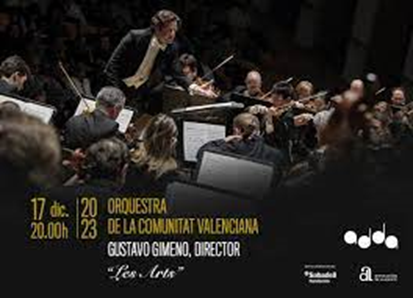
Gustavo Gimeno and the Orquestra de la Comunitat Valenciana in Sibelius and Mahler


Gustavo Gimeno conducted the Orquestra de la Comunitat Valenciana in the latest concert of ADDA’s Pasions season. The program juxtaposed two symphonies that were premiered about thirty years apart by composers who were both born in the 1860s. The contrast, however, was immense.

Composed almost at the end of Jean Sibelius’s creative life, the Seventh Symphony is much more revolutionary than it might appear at first sight. Its compressed form is perhaps more reminiscent of a tone poem than a symphony, but at twenty minutes duration, its single movement is longer than many eighteenth century symphonies that advertise multiple sections. And here there is a sense of development, even evolution as motifs come and go, resurface and transform in this seemingly organic form. The whole takes on the feeling of a valediction, with the trombones effectively waving goodbye, hardly animated, but certainly determined, to a creative life that was soon to be retired.

Sibelius’s Seventh Symphony is a very moving work, full of wonderful, slow textures, where sounds seem to melt at the edges as they brush past one another. The Orquestra de la Comunitat Valenciana under Gustavo Gimeno’s direction, played the work sympathetically, always keen to bring these textures to the fore.

Gustav Mahler’s First Symphony, by contrast, came at the start of his composing career. Its gestation was protracted, and the composer revised the score almost each time it was played during its first five years.

The result, however, is an often-played masterpiece. Only two of Mahler’s symphonies, the first and fourth, are of half concert length, and the fourth needs a soloist. This makes the first symphony the easiest of the composer’s output to programme, and so one feels that its presence might sometimes be perfunctory. An orchestra wants Mahler on its curriculum vitae, and the first offers the least resistance.

But there was no such pragmatism on show for Gustavo Gimeno and the Orquestra de la Comunitat Valenciana, who had clearly rehearsed the piece at length. Here we had a reading and performance that stressed detail and contrast. Mahler’s juxtaposition of light and heavy, light and shade, loud and soft, fast and slow were perfectly communicated and played. But this was no mannerist display of the possible for possibility’s sake. Here all the lines were well drawn, and the overall shapes made sense, musically at least, which is often not the case with this intentionally episodic work.

It was so detailed that the musical allusions came to the fore. The funeral march’s juxtaposition of popular song alongside Jewish celebration was clear and also stark, and it seemed to be delivered with the wry smile that no doubt the composer wore while writing it. Also evident was the similarity at one point to the Fifth Symphony’s Adagietto. Also notable in the scherzo, just before the contrasting slow trio, there stood out of figure in the cellos, just a series of repeated notes, that were lifted verbatim by Shostakovich into his fourth symphony. No perfunctory presence for this symphony for that great composer.

Mahler’s rousing finale was delivered by standing brass and horns, but it was the whole orchestra that shone. Gustavo Gimeno was careful to present each section of the band for acclaim at the end. They had all deserved the applause.


Thursday, December 14, 2023

Josep Vicent conducts Beethoven and Montsalvatge in Alicante


Beethovens Ninth Symphony is one of those works I can hear anytime I want. I play it to myself in my head - at least, I think I do. It's a work I and many others have heard so many times, I sometimes wonder what might be gained from hearing it again. On this occasion, I need not have worried.

This is always a concertgoer’s dilemma, at least, if you are a concertgoer like me, who always craves new and original experience. There are many concertgoers, perhaps even a majority, who want only to hear what they know, hence the rather repetitive and perhaps, at least to me, the rather stultified and predictable nature of a lot of programmes.

As a season-ticket holder, however, one does tend to go to whatever is billed, and on Sunday, 10 December 2023, Josep Vicent and the ADDA orchestra chose to play Beethoven Nine.

I tried to remember the last performance of the work I attended. It must have been that Promenade Concert over twenty years ago that I attended with an old college friend, when an original instrument group performed it. “It’s being sung on the original voices,” said my friend with more than a smile. We were a long way from the stage in London’s Albert Hall. The work, of course, filled the space. More often than not an overlooked but regularly visited friend is full of surprises when we do finally make contact.

And it was true with this performance of Beethoven Nine. There were even surprises in Josep Vicent’s reading. The opening bars, for instance, are so often played with the first violins cutting forte through the general tremolo. Here they were subdued, understated. In the last movement, when the famous theme establishes itself on wider strings after cellos and basses have introduced it, Vicent had the woodwind come almost to the fore with its argumentative counterpoint. Thirdly - and what a masterstroke! - the presence of the chorus on the stage meant the timpani had to move. Vicent brought it almost to the front of the stage alongside the violas and cellos. The timpani, of course, plays a thoroughly significant role in the work, and not only in the groundbreaking second movement, where it played melody for perhaps the first time. The four soloists, Erika Grimaldi, Teresa Iervolino, Airam Hernández and José Antonio, were all more than up to their tasks. Positioned just ahead of the chorus, they sang with remarkable clarity, volume and commitment.

But the real star of the show was the chorus, Orfeón Donostiarra. The chorus were not just committed to the task, they sang as if their lives depended on it. But they were always totally musical, never prone to stress volume rather than tone, always accurate, with every dynamic change respected. The amazing quality of their work was recognized by the audience’s loud cheers at the end, a gesture that was both noticed and appreciated by everyone present.

In the first half we had Montsalvatge’s Cant Espiritual de Joan Maragall, a twenty minute work for chorus and orchestra. Maragall’s words concentrate on the prospect of life after death, in contrast to Schiller’s which, as we know, are really interested in the here and now. Montsalvatge’s music, understated neoclassicism, mixed with modernism and popular song, came across as the perfect foil to the grandiloquence that was to follow. But in Beethovens case, the grandiloquence works every time. It’s grandiloquence with consequences and theres not an empty second in the experience. In our current world, we need more, not less calls for brotherhood and sisterhood amongst all people.


Saturday, November 25, 2023

Pimchas Zukerman plays Elgar with Orchestra National de Lyon under Nikolaj Szeps-Znaider in ADDA Alicante


When writing reviews, the pressure to express opinion often leads to overstatement. It is a position. I usually try to avoid, and I do so by concentrating on the positive aspects of the object under review. I will do the same here.

To say that everyone went away happy from this evening of Elgar and Brahms would be an understatement. They had been treated to an outstanding performance by an outstanding violinist. They had also been delivered a going-away lollipop in the form of the ever-popular Nimrod variation from Elgar’s Enigma to round off the evening.

Pinchas Zukerman is now seventy-five years old. He has been making music in public for over five decades of his life, and if anything, he seems to get better with time. There are few pyrotechnics to see in his playing. But when the eyes are closed, the true force of expression becomes clear in all of its colours.

The Elgar Violin Concerto that started this evening was beautifully played. Its complexity of argument, where orchestra and soloist seem regularly to exchange roles and material, seems like an intellectual process at times, an intellectual process that is conducted purely via emotion. This Elgar concerto is a thoroughly modern piece, dressed in nineteenth century form, as evidenced by the unconventional techniques the soloist is directed to use. Brahms, and indeed Mendelssohn are here, but so is the idea that violinist and orchestra combine and compete in dissecting a musical argument. This is no simple showpiece for a soloist to fill with emptiness.

And the communication between artist and orchestra this evening between Pinchas Zukerman and the Lyon Orchestra was superb. The soloist even joined in with the first violins here and there to keep himself busy. His tone throughout was a joy to hear, as was his obvious understanding of the problematic score. Elgar was always a showman, but his lack of personal confidence always persuaded him to be retiring. He considered himself an outside, an underdog who was always trying to gain entry to an establishment that he felt shunned him. It is rather strange, contradictory even, given that his music is now seen as thoroughly “establishment”. Personally I hear this dichotomy in the music, as exemplified so often at the start of his pieces, which sound is if we are entering into the middle of a conversation that was already underway before we arrived. It’s as if the composer is apologising before he has said anything!

After the interval, the Lyon Orchestra played the Symphony No. 1 of Brahms. Its an orchestral standard, which, surely, most full-time professional orchestra have played many times, and can probably render convincingly from memory. It can be a challenge, not least for a member of the first violins who lost a string. She proceeded to play through the piece as if the problem did not exist. Remarkable and congratulations!

Personally, I dont have much to say about the Brahms Symphony, except that if it had been written in the age of recording technology, Johannes Brahms would have been labelled a plagiarist. History, however, might mark the influence of Beethoven in his music as “inspiration”. It was an inspiration, as we know, that caused the composer, great difficulty, and perhaps this symphony had to be written to unleash creativity that otherwise would have found no voice. 

Another great ADDA evening.


Monday, November 20, 2023

Jesús Reina, Pierre Bleuse and ADDA Alicante in Ravel, Strauss and Mozart

For the third time this season, Alicantes ADDA audience heard a major piece by Richard Strauss. The Violin Concerto is an early work, written when the young man was a teenager and still searching for a mature voice. As a consequence, it does remind one of Brahms, Mendelssohn here and there, amongst others.

But its overall conception is quite different. For a start, there is no obvious cadenza. Even at sixteen years of age, Richard Strauss was trying to write a concerto where soloist and orchestra were to combine to deliver an integrated musical experience. This was never conceived as a vehicle to allow a soloist merely to show off. And so it needs to be performed cooperatively, with the soloist always mindful of the orchestra’s contribution.

On this occasion, the soloist was Jesús Reina, a musician who devotes much of his time to playing chamber music in small ensembles. If anyone would be sympathetic to this need for integration, then, surely, he would be. The audience was not to be disappointed. He was so completely sympathetic to the orchestra’s role that he often turned during the time when he was not contributing to face the orchestra and actually listen to what they were playing. The result was a truly integrated work, with a musical argument coming to the fore. Pierre Bleuse’s direction also allowed the perfect balance to develop.

The concert had begun with the orchestral version of Ravel’s Le Tombeau de Couperin. Now this work is often played almost as if it were conceived as an eighteenth-century concerto grosso, rather than an homage to the form from the point of view of a twentieth century composer.

This performance crafted by Pierre Bleuse was different. The shape was still there, but the hard, staccato edges seem to be softened. The strings seem to be offering commentaries rather than statements. The result was a beautifully balanced, surprising and thoroughly post-impressionist, twentieth century piece. It paid homage to the past while saying something quite new. It is such a familiar piece, but what a surprise!

Mozarts G Minor Symphony occupied the second half of the concert. It is hard to find anything new to say about the work, but it is also a work that does not need novelty. It is so well crafted, so perfectly conceived, that it makes its own points every time it is played.

Pierre Bleuse’s direction brought out every aspect of Mozarts score. It was serious, threatening, lyrical, playful, and always inventive. A real treat brought the evening to a close in the shape of Chabrier’s Habañera, a surprisingly subtle an interesting little piece. Another surprise!

Monday, November 13, 2023

Orchestra of the Royal Capital City of Krakow under Katarzyna Tomala-Jedynak in ADDA Alicante

Surprises come when least expected. On entering the ADDA auditorium, it was at least a shock to see so little of the stage occupied. So used have we become to seeing a platform crammed with seats and percussion hardware in preparation for a “big” work that the apparently scattered chairs and stands that awaited the arrival of a moderately size string orchestra was at least startling. And there was to be only one double bass!

Providing a perfect example of the phrase “less can be more”, the orchestra of the Royal Capital City of Krakow proceeded with a program that surprised and delighted the audience almost with every note.

We began with the Sinfonietta Number Three of Penderecki, a reworking for string orchestra of his String Quartet No. 3, subtitled “Pages from an unwritten diary”. The composer’s style, outside of his religious works, tends towards the episodic. Seemingly simple ideas come and go, and via abrupt transitions and apparent non-sequiturs, we are led around an idea that reworks itself, perhaps without reaching even musical finality, let alone a position of argument or comment. Celebrating Penderecki's 90th anniversary, this piece’s subtitle was apposite. What might have been written if this diary had been complete? The Sinfonietta Number Three is thus an example of what might have been, its apparent raw edges deliberately left unsmoothed.

There followed a performance of a thoroughly different kind of work. The Concerto for String Orchestra by Grazina Bacewicz is a masterpiece. She uses the string orchestra in a largely neo- classical manner, in a way that seems to alternate between the concerto grosso and sonata form. But there are also harmonies here that come from popular music, and all this is encased in a rhythmic drive that never lets the piece flag in its apparently relentless progress. It is succinct, tightly argued, and makes perfect sense in a surreal, unexpected way. Clearly, this is a piece that the orchestra plays often, and they clearly enjoy it every time.

The real surprise came after the interval with Mendelssohn’s Ninth String Symphony. The product of a mature mind aged about twelve, the piece is an astounding achievement. It is tightly structured and musically convincing. The surprise comes in the slow movement, which Katarzyna Tomala-Jedynak did not try to conduct.

Using just eight players, the movement begins with four violins in counterpoint. There follows a balancing section of two violas, cello and bass, before a conclusion, where the four violins are joined by the others in an octet. Treating this as chamber music and leaving the decisions to the players emphasized the whole program’s closeness to the chamber music experience. By the end, the communication that this engendered between performers and audience more than compensated for the lack of volume. The orchestra of the Royal Capital City of Krakow offered a short, but energetics dance movement as an encore.

Sunday, October 29, 2023

Antonio Pappano, Yeol Eum Son and the London Symphony in Kendall, Liszt and Strauss in ADDA, Alicante


When it comes to star billing, in the world of so-called classical music, there is no bigger ticket than Antonio Pappano directing the London Symphony Orchestra. The maestro, who perhaps will forever remain linked to his day job for decades, as the musical director of Londons Royal Opera House, is to take up the role of Chief Conductor with the LSO next year. This concert, already performed this month in London in the Barbican Hall, albeit with a different soloist, marks the start of that cooperation. Alicante’s ADDA audience last night had the privilege of sharing its music.

The main work on the program was Richard Straus’s Also Sprach Zarathustra. Its one of the composer’s early tone poems, and, perhaps uniquely in music, is not only based on a book, but on a work at philosophy, albeit presented as a fiction. Nietzsche’s ideas announced to the universe that there was no God. And thus human beings must develop a new way of relating to experience, a new way of relating to the world in order to live. It was the will that now asserted itself, not a faith.

Strauss’s tone poem opens with finale, a brass fanfare complete with organ that has become a pop classic. What follows is veritably an examination of the breadth of experience that a symphony orchestra can present. So vast is the range of sonorities wrapped within this half hour that often the listener has no idea where the sound is coming from. Split strings, soloists from the front desk, widely spaced harmonies for unlikely pairings, a double bassoon and a tuba competing for the bottom space, married to a complexity of orchestration that is sometimes almost bewildering, all this contributes to the effect of this remarkable work.

It is, however, fifty years since I last heard it in concert, and it might be fifty more before I attend again. For all its stunning sheen, there is also something lacking in its vision. Though Strauss insists on a programme of selected chapters from the book, too often I find alpine meadows, heroes, lions, dandy pranks, heraldic delusions, and even merry pranks surfacing. What is lacking, therefore, is an intellectual direction that justifies the title. It was Richard Strausss problem: the music he wrote is undeniably wonderful.

The playing of the LSO was utterly wonderful. The sound of this orchestra seems to be more integrated, more balanced than most. But when a solo voice is needed to stand out, stand out it does, and with elegance. The evening finished with an encore of an eastern European dance, which added almost a full stop to the open ending, perhaps a question mark, pianissimo pizzicato, of the tone poem.

Earlier, we heard Yeol Eum Son in Liszt’s Totentanz. “Tour de force” could equally have been its title, for it makes huge demands on the soloist. It seemed, however, that Yeol Eum Son hardly noticed, so complete was her control over Liszt’s taxing variations. It was a superb performance, appreciated by the audience to the extent that Yeol Eum Son offered some Moskovsky Sparks as an encore.

The evening had started with a work commissioned by the LSO from Hannah Kendall, a British composer, who seems to win competition prizes at will. Many of her works examine cross-cultural musical forms, and “Oh, flower of fire” was indeed related to cultural identity expressed through sound, and this identity’s search for a home. Scored for a large orchestra, the work rarely used tutti. There were long periods when all the strings were silent, and then, when they were called to play, only made passing phrasal comment.

But what this music was clearly about was the memory of West African music, as transplanted by slavery, the violent orchestral tutti, to the Caribbean. The doctored harps alongside percussion sounded like a kora being plucked in the marketplace. The violence of the orchestral interjections was surely calculated. And so, often at the limit of human hearing, surely implying the small voice of the oppressed, Hannah Kendall explored textures, sonorities and colours that were as surprising in 2023 as Richard Strauss’s surely were in 1896. In Hannah Kendall’s case, the philosophy was a more obvious part of the experience, perhaps because of the changes in human society, the rise of the individual, presaged by Nietzsches argument. Now we are more atomized.

At the end of the piece, Antonio Pappano actually conducted the audience. He clearly wanted silence to follow the last notes and an outstretched left arm with index finger extended kept everyone quiet for a good ten seconds.

Monday, October 23, 2023

Congyu Wang - 24 Oct Denia International Piano Festival


Congyu Wan's playing was explosive and at the same time tender. He has definitely thought about every phrase. But he does not over-shape or over-interpret. The emphasis is where it needs to be, the rubato is applied, but never overdone. The dynamics are wide, but never over-emphasised. He has a tendency with Chopin to slow the piano and accelerate the forte. In concert it works beautifully, but the approach might not get past a nit-picking reviewer on disc.

He chose to play the Chopin Nocturne and the Liszt Liebestraum together, deliberately holding off the applause at the end of the Chopin. The effect was to increase musical tension. The Denia audience was spellbound to silenece anyway! Quite memorable. The Earl Wild arrangement of the Vocalise transforms the melody into what sounds like another prelude to add to the Rachmaninov set. There’s a central section that is explosive. After that the Kreisler Libeslied sounds like a show-off piece, which is what it is, but the Rachmnaninov harmony saves it and, indeed, makes it interesting. The Gershwin preludes again sounded more pianistic than usual. Just a little research shows that Earl Wild reworked seven Gershwin Preludes – the usual performance does the three that Gershwin himself published under the title. These pieces were quite different. Highly pianistic and with recognisable melodies that kept poking through the notes. The overall effect was wonderful and simply put brought the house down.

After that, Congyu Wang then embarked on Gaspard de la Nuit. Now this is a challenge at the best of times. It is virtuosic in a way that perhaps only Ravel could write. It’s a style that is unique. It sounds literally like no-one else. But what demands he makes to mimic simplicity! One feels that Ravel always wanted to simplify, but the way his mind worked was just different from the rest of us. The pianistic elements don’t feel like decoration. They are essential elements in the music’s sense.

Congyu Wang’s playing was breath-taking. The emphasis here was in the contrasts. Slow-fast, quiet-loud, the contrasts seemed emphasised, but never mannered. Add to that the rhythmic tension that is always part of Ravel's thinking and the result is this masterpiece of the concert hall. He had really thought about the overall shape of the piece and that came across with clarity. Just what the rather strange mind of Maurice Ravel had in mind we will never know. What is clear is that the place he lived was not quite in this universe, such a transporting experience does his music offer - and this performance in particular.

And then, at the end of the programme, we heard Aldoraba de Garcioso. This is Ravel in “Spanish” mode and the audience will have been totally familiar with the musical phrases and harmonies that keep surfacing in this consciousness stream that is pure Ravel. The playing was again beyond brilliant, but always sympathetic, never spectacular just for effect. Congyu Wang is a true artist.

There followed three encores. Chopin, Debussy and more Chopin. The audience would have stayed for more, but after a programme like that at least one person involved deserved a rest.


Saturday, October 14, 2023

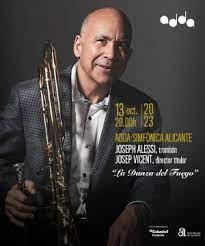
Memorable? You bet! Joe Alessi plays Chick Corea’s trombone Concerto at ADDA, Alicante

The word memorable is much overused. It now tends to signify something that is rather bland, an experience unworthy of being labelled “world class”, “incredible”, “iconic” or some other meaningless malapropism. And if something is truly memorable, how long would we expect that memory to last? A minute? An hour? A lifetime?

Last night’s concert in ADDA, Alicante, was memorable. Its music alongside its experience will live in my own memory for the rest of my life. And it wont be at the level of a distancing or fading recollection. This musical experience will forever be vivid, enhanced by Chick Corea’s wholly original score, and Joe Alessis skilled and committed playing.

Trombone concertos have been pretty thin on the ground until recent years. That is strange, because the instrument, also known as the sackbut, has been an orchestral feature for many centuries. In the past, of course, before the technological enhancements of the last two centuries, the instrument might have been used purely primarily for volume and had a reputation for clumsiness. A change of key might even need a different instrument. No more.

Chick Corea was a famous performer. His most familiar style was jazz, performing as a soloist or alongside the great names of the musical language. Chick Corea the bandleader and improviser we know from recordings, but Chick Corea the composer is less well-known. The trombone concerto that Joe Alessi commissioned from him turned out to be his last composition. Chick Corea apparently wanted to end the work quietly, but Joe Alessi plucked up the courage to ask him to change approach and up the excitement at the end. One would never have known there had been any change, so wonderfully did the work communicate its intentions.

What was so striking about the music was its apparently complete originality. Every phrase seemed to exist in a sound world new to the audience, to explore sonorities that even a concert goer with almost a lifetime of memories found not only surprising but striking. And these textures, generally, were delivered at a whisper, never a shout. Yes, there were jazz idioms, but there was also Charles Ives here (perhaps also walking around New York) and Copeland, amongst others. Presented as a stroll, followed by a couple of dances, punctuated by a little anguish, the music promised a relaxed meandering around tonal centres. But Chick Coreas rhythms, let alone his harmonies, are rarely predictable. Rhythms break, and there are hooks sticking out that catch you as you pass. The listener is constantly lulled into assured familiarity only to be presented with sonorities and trips that keep the concentration fixed on where the next step might fall. The dances and the strolls therefore force you to notice everything, because it may trip you up.

Memorable it was. It’s a work and a performance that will live in the mind as long as I do, not least because of Joe Alessi’s wonderful performance. It was not just virtuoso. It was committed in a way that communicated his obvious and complete love of the piece. And the ADDA audience in its entirety shared the emotion and commitment of all of the performers, who, collectively, and Joel, Alessi in particular, made their work and our evening so utterly memorable.

Joe Alessi played what he described as a love song as an encore, perfect he said, for a daybreak stroll along Alicante’s waterfront. And then, buy popular request, we heard the coda from Chick Corea’s concerto a second time, its high note ending asking the soloist to work hard again. I am sure it was a labour of love.

The rest of the concert will live alongside the memories. Mussorgky’s Night on a Bare Mountain opened the evening. The unconventional music of Mussorgsky was revelatory, if not, always competent or coherent. The piece, however, is a complete success in its orchestral version. Not all visionaries of capable of perfection, as Repin’s portrait of the composer graphically illustrates. There is a lot going on.

And in the second half, we were presented with what promised to be the main event in the form of a performance of Stravinsky’s Firebird ballet, alongside a film by Lukas van Woerkum, which offered a suitably silent, balletic re-interpretation of the fairytale. The effect was spectacular, but personally, I found that the visual sometimes caught me not listening to the music. As ever, the ADDA orchestra under Josep Vicent played faultlessly and the interpretation was nothing less than both faithful and spectacular. The film did make me listen to the piece in a different way. It was memorable effect, however, on a memorable evening.