Friday, February 7, 2025

Esther Yoo, Lahav Shani and the Munich Philharmonic in Mendelssohn and Bruckner in ADDA Alicante


What new observations might one have of an event featuring Mendelsohn’s Violin Concerto in E minor and Bruckner’s Symphony No9? These are both works that I have heard many times over the years and several times each in the concert hall. Recordings of them exist in myriad interpretations - especially the Mendelssohn, which, along with concertos by Beethoven, Brahms, Bruch and Tchaikovsky, is amongst the most played violin concertos in the concert hall. Audiences, however, are renowned for liking what they know, so, despite the regularity of its performance, this particular concerto features in most concert seasons of most orchestras.

What is new about every presentation of a work, no matter how often it is played, is the performance. And on this occasion, the soloist was Esther Yoo and the orchestra was the Munich Philharmonic, under their soon-to-be resident conductor Lahav Shani. Esther Yoo’s playing with superb, committed, expressive, and always engaging with the music, never merely playing the notes. Unusually, Lahav Shani chose to conduct without a score. Often, even the most accomplished and experienced conductor uses a score when directing a concerto, perhaps to underline that if anything goes wrong, it is the responsibility of the soloist. But on this occasion, Lahav Shani showed he knew the music so completely that the presence of the score would have been simply redundant.

This was indeed a spirited, and at times a thoughtful performance of a work that always has the potential to become a cliché. The performers ensured, on the other hand, that this utterly familiar work became an original, fresh statement. Esther Yoo’s performance was warmly received by the ADDA audience, and she offered an unaccompanied sarabande by JS Bach as an encore.

And what more is to be said about Bruckner’s Ninth Symphony? Unfinished it might be, stopping at the end of a slow movement placed third, though it still lasts more than an hour. Personally, I find that I can always admire Bruckner’s music from afar, but I find repeatedly that it never invites me inside its world. The composer, apparently, was writing cathedrals in sound, giant blocks of stone and glass piled high. And, as if we were looking up at a ribbed and vaulted Gothic roof, we know that it is heavy, and we know that it is solid, but in detail, it is often light and often even soaring.

Again, Lahav Shani chose to conduct without a score, but his attention to detail throughout was precise and expressive. The Munich Philharmonic definitely makes a sound commensurate with the demands of this work, and on many occasions the tutti actually felt physically massive. But this orchestra is also completely subtle in its playing, and the textures provided by the composer’s orchestration were always to the fore.

In Alicante, we are used to an orchestra that is totally committed to the musical experience, and it is therefore the highest praise possible for this audience member to say that the Munich Philharmonic was at least as good as our regular experience. It goes beyond praise to know that many of those present thought that this orchestra surpassed our norm. Now that is something new.

Saturday, February 1, 2025

Historias de la Guerra - Josep Vicent, Yol Eum Son and ADDA Simfonica play Gershwin's Piano Concerto and Shostakovich Eight


This was a concert of two very unequal halves, at least in length, let alone style. The two parts were equal when it came to their standard of performance, however. A program that pits Gershwin against Shostakovich, especially in the latter’s most bleak form, is always going to present a contrast, and a both delightful and thoughtful contrast it proved to be.

Now I admit that I am biased. I first heard Shostakovich’s Eighth Symphony in London under Kiril Kondrashin in the early 1970s and the work has stayed firmly in my listening habits ever since. It is not, however, a work to which I listen regularly, maybe once a month at most, because it remains a harrowing experience, no matter how familiar one becomes with its argument.

Shostakovich’s three war symphonies deal with conflict in number seven, victory, albeit hollow, in number nine and raw suffering in number eight. Such subject matter makes number seven, paradoxically, the most accessible of the three with its self-delusion of an apparently triumphal ending. Number nine is so hollowly cynical that it becomes a talking point rather than a musical experience. Number eight, on the other hand, is visceral in its content and thus disturbing in concert. But, from time to time, it is good to be disturbed, to be reminded of the consequence of certain kinds of human behaviour. The fact that it is human behaviour is obvious, by the way, since other life forms do not make bombs.

The concert’s first half offered contrast with the anticipated suffering that was to follow. It was a performance of Gershwin’s Piano Concerto by Yol Eum Son. This is music of sheen and gloss. As piano concertos go, this one is dressed up for a night out and is packed with references to the popular culture of the time, the roaring twenties, the jazz age. But there is enough in the solo part to link it with works in the same genre by Bartók, Prokofiev, or even Rachmaninov in its simultaneously percussive and lyrical style. There are times, unfortunately, where the soloist becomes overwhelmed by Gershwins rather heavy orchestration, but that is clearly how Gershwin wanted things. Despite sometimes being eclipsed, Yol Eum Son played with such perfection that her performance was at times breathtaking, both technically brilliant, and musically considered. The experience was further refined by Josep Vicent’s direction of the ADDA orchestra. The rehearsal time had clearly been well used, with the orchestra entering the idiom of Gershwin’s work as well as playing the notes. With an orchestra of the standard of Alicantes ADDA, however, this might be possible without rehearsal!

Overall, the Gershwin Piano Concerto shows off everything that is good about the composers music - directness, melody, rhythm and good-time sheen - alongside everything that is less than wonderful, being the broad brush of the composer’s orchestration and the frequent dominance of effect over content. But this program was perfection as far as this work was concerned. Yol Eum Son finished with the piano arrangement of Gershwin’s Summertime by Earl Wild.

And so to the Shostakovich, which was written barely twenty years after the Gershwin, two decades that had seen Gershwin’s celebrating world view become depression, and then war. If the first part of this concert approached perfection, then the second part definitely achieved it.

Josep Vicent clearly programmed this work to coincide with the eightieth anniversary of the liberation of Auschwitz, a point he made while addressing the audience at the end. But also this work clearly occupies a special place in his musical thoughts. He chose a very slow tempo in the opening movement and thoroughly respected the composer’s dynamics amongst the strings. It is often overlooked that the first violins only enter when the marking is pianissimo. This allowed him to stress the changes in dynamics and rhythm that followed to dramatic effect. And in this symphony, Shostakovich uses his often-explored technique of a long moderato with a central allegro climax, and then a denouement, usually featuring a solo instrument. In this case, it is the cor anglais accompanied by a sustained tremolo that often causes string players to tire. Here, this perfect was – yes – perfect played, paced and interpreted.

Personally, I find that the work’s core, however, is the fourth movement, the slow, highly internalized examination of grief and loss. This is music that invites you into its world. As an audience member, you have to become part of the performance because this music forces you to confront the emotional cracks that Gershwin, for instance, would simply paint over. It is also why this Symphony, to my ear, works only when heard in concert since this participatory element, this communication between performers and listeners is less intense in a recording.

At the end of the Eighth Symphony, Shostakovich allows the music to settle into its own sleep. Everything dies away, but we are left very much alive with the memories that it provoked. The audience’s silence at the end of the work was indeed part of its effect and surely part of its performance. Well done the ADDA audience! A performance of this work will last in the memory forever, if the work is played well and with commitment. Needless to say that this performance by Josep Vicent and the ADDA Orchestra satisfied in every aspect.

Shostakovich’s Eighth surely does not need an encore. But if it is to have one, Josep Vicent chose a perfect ending in Ravel’s Pavane for a Dead Princess. This works still concentrates on loss, but the Ravel offers a little sweetness to round off a savoury meal. And Ravel’s subtle orchestral touches really do enhance the musical experience, reminding us of the fact that Gershwin once asked for classes from Ravel to improve his technique.


Saturday, January 25, 2025

Cappella Andrea Barca and Sir András Schiff play Bach and Mozart in Alicante


CAPPELLA ANDREA BARCA

SIR ANDRÁS SCHIFF, DIRECTOR Y PIANO

Johann Sebastian Bach, Concierto de Brandemburgo nº5 en Re Mayor (BWV 1050)

Wolfgang Amadeus Mozart, Concierto para piano núm. 25 en Do mayor, K.503

Johann Sebastian Bach, Triple concierto para flauta, violín, clave y cuerda en La menor (BWV 1044)

Wolfgang Amadeus Mozart, Concierto para piano núm. 24 en Do menor, K.491

Sir András Schiff is renowned worldwide for his interpretation of the music of Mozart and Bach. I admit at the start that I respect the music of both composers and even recognize the gargantuan achievements of both. But rarely do I feel anything other than respect when I hear performances of their work. Sometimes, performances rise above my prejudice, and I am always delighted by these insights into the musical personalities of Bach and Mozart that a musician can reveal. It’s not that I actively dislike this music, it’s just that it rarely surprises me. So it was with preconceived expectations that I approached last night’s ADDA Alicante concert.

The program presented by András Schiff and Cappella Andrea Barca, the orchestra the soloist himself constructed to play alongside him, included two works from each composer. All four works were called concertos, but the Bach versions each featured three soloists. The works in question were the Brandenburg Concerto No5 and the Triple Concerto, BWV1044.

Besides having a significant part for a keyboard soloist, these two works also feature solo violin and solo flute. Indeed, the central slow movement of each work features only the three soloists, so here both works become chamber music.  Cappella Andrea Barca’s leader Erich Höbarth was the violin soloist in both works. The orchestra’s two flautists Wolfgang Breinschmid and Wally Hase took turns to solo in the Brandenburg and the Triple respectively.

It is rare for me to criticize anything, but this will be one occasion when I do so. The flautists were both wonderful. Their playing was faultless and was delivered with obvious enthusiasm and commitment. Erich Höbarth, I am sure, is an accomplished violinist, but in the ADDA Hall last night, it was difficult to hear his part. This may be quite harsh, since the violin soloist is often playing along with the first violin part, but even on those occasions when he was playing alongside only the other two soloists, such as in the two slow movements of both concertos, his contribution remained barely audible. Now a flute can be an assertive voice, but neither flautist was playing in such a way as to deliberately drown out a colleague, let alone the leader of their own orchestra!

The two Mozart works were piano Concerto No24 and No25. The first one is a rather gentle affair to my ear, presenting a simple, perhaps over-simplified theme in a very simple way. Number 25 has more substance and is longer than its predecessor. András Schiff both directed and played the solo part with great ease. A grand piano is a perfect way of communicating a Mozart concerto, but many keyboard players would choose a smaller voice for the Bach works. In the hands of András Schiff, however, a lightness of touch and an obvious sympathy with the performers meant that the keyboard never dominated. One really felt that this orchestra loves playing with András Schiff and that everyone loves this music. But there again, there were times when there was more than a hint of “we have been here before”.

The audience demanded an encore and András Schiff delivered a Bach fugue. Everyone went home happy.


Tuesday, January 14, 2025

Josep Vicent directs ADDA Simfonica in Rimsky-Korsakov and Bizet, Scheherazade meets Carmen


When you go to concerts regularly, there are works that tend to appear frequently. After the first few times in the concert hall, there is always a temptation to say “not again” and avoid the evening. On the other hand, the irregular concertgoer is often attracted by these familiar works, and without fail including them in a programme will put bums on seats. Both opinions are wrong. Not only is the unfamiliar more likely to provide memorable experience, but the familiar is also experienced anew every time it is performed. If the work is played well and generously interpreted, there is always something original to be found.

This preamble thus introduces a review of ADDA Simfonicas concert of last Saturday which featured Rimsky-Korsakov Scheherazade and Bizet’s Carmen Suites.

Scheherazade is a symphony in all but title. Alternatively, it might even be heard as an approach to a violin concerto, a kind of Ein Heldenleben before its time. Its four movements roughly follow a symphonic mould, but there the analogy disappears. The music is in fact, much more like Wagner than Brahms, with not only a programme, but also musical germs which are heard like leitmotifs. Josep Vicent was clear in his notes that the composer himself did not consider these thematic motifs as anything other than ideas stemming from the natural development of the material. But in fat they are a tad too literal to be anything Wagner-style leitmotifs,

Josep Vicent’s interpretation with our beloved orchestra stressed both the realism and the dynamics of the piece. Though an expert orchestrator, Rimsky-Korsakov’s style does at times appear to be rather “on” or “off”, there being apparently very little between pianissimo and full tutti. And in those tutti, the orchestral sound is thick, deliberately so, and undeniably rich, with the tuba always filling out every possible space beneath.

And what a performance this was - captivating, exciting, certainly dynamic, but always subtle. Anna Nilsen’s violin playing from the leaders chair was exquisite, as was every contribution from the harp. It was a program that certainly re-opened my ears anew to a work that I have heard many times.

And speaking of the familiar, Bizets Carmen Suites that followed were surprisingly subtle in terms of orchestration compared to the first half. When, I wonder, was the last time a concert review described Bizets orchestration as light? It is. After all, a relative judgment.

Music works in strange ways. As a child, Bizet’s music for Carmen became familiar via a television advertisement for a brand of petrol and to this day whenever I hear the massage I silently sing-along with these wrong words, thus preserving a brand name for gasoline that still exists. So for me, the familiarity got the better of the experience with this music. But the performance was nothing less than excellent. The tunes flowed, the drama was tense, and the music was always centre stage.

There was an encore. Josep Vicent and the ADDA orchestra had recently played Brahms. Ironically, given this evening’s programme, the conductor announced that no matter how many times his music is played, there is always some space for more Brahms. The audience was then treated to a passage from a symphonic slow movement. The experience was a theme for the evening.


Tuesday, December 17, 2024

Denia International Piano festival, Programme 17 December Prodigios


Prokofiev, Romeo y Julieta en ADDA Alicante


ADDA·SIMFÒNICA ALICANTE

JOSEP VICENT, director titular

ASUN NOALES, dirección escénica y coreografía

Rosanna Freda, asistente de coreografía

Joaquín Hernández, Diseño Iluminación

Luis Crespo, Diseño espacio escénico

Ana Estéban, Vestuario

Federica Fasano, Investigación

Germán Antón, Fotografía

Bailarines: Deivid Barrera, Rosanna Freda, Diana Grytsailo, Iván Merino, Alice Pieri,
Laura Martín, Joel Mesa Gutiérrez, Salvador Rocher, Theo Vanpop, Jennifer Wallen,
Samuel Olariaga, Araitz Lasa

What can surprise in a performance of music that is almost known by heart, providing a scenario for a ballet whose story one has heard and seen performed countless times? The answer is just about everything. A story is as old as its current telling, if the tellers have told it their way. This was very much the case last night in Alicante when the ADDA Orchestra under Josep Vicent played Prokofiev’s Romeo and Juliet to the choreography of Asun Noales.

One always needs to be reminded of the power of human imagination, and this performance will live log in the memory. Here there were no sumptuous costumes, no monumental sets. Staging was accomplished with a few cubes that could serve as seats, walls or plinths, and a pair of steel scaffolds that had vegetation on one side. These could be rotated to present a garden, a balcony or a tomb. Costumes were minimal, with the feuding Montagues and Capulets needing no obvious uniforms to identify their allegiance.

But what was on display was raw emotion, vividly portrayed by a quite excellent choreography. There was not a single gesture in the audience’s view merely for the sake of the gesture. Nothing was purely technical. Everything meant something.

The audience was left in no doubt about the sexual nature of Romeo and Juliets mutual attraction. And the fight scenes were utterly convincing, despite the fact that no weapons were ever visible.

Perhaps the most surprising aspect of the whole evening was the portrayal of Father Lawrence. Prokofiev’s sensuous music was the raw material, but the choreography depicted a character that was sinister, clearly devout and all too willing to help, but also someone who wished to envelop and control. It was a depiction close to witchcraft, but probably got closer to a medieval mind’s interpretation of religion, with its capacity to deliver eternal damnation and suffering than any other I have seen.

Rosanna Freda and Salvador Rocher in the principal roles were hardly off stage, but other performances were also superb, not least the Mercutio, the Tibalt and the Nurse. And everything was delivered by a dozen dancers.

This was a minimalist production with wholly modern choreography, but the humanity that was depicted was direct, very moving, and communicated so vividly that it rendered considerations of “style” simply irrelevant.

Monday, December 2, 2024

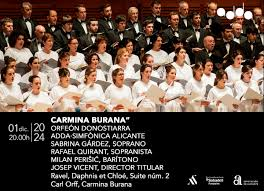
Orfeón Donostiarra, ADDA, Josep Vicent serve two staples of twentieth century music in Alicante - Orff's Carmina Burana and Ravel's Daphnis and Chloe


How does one review a work in which one section is so well-known that it is perhaps better known as an aftershave advert on television than is a piece of music? How might one describe again an experience that has already been played through on multiple occasions? Here is the problem for this reviewer of last night’s concert in Aliante, in which the ADDA orchestra under Josep Vicent alongside Orfeón Donostiarra presented two utterly familiar masterpieces of twentieth century music. Lets start with the aftershave

Given the opening paragraph, “old spice” is perhaps a good label from which to start. Carl Orff’s Carmina Burana is perhaps an example of old spice. Since its rapturous reception in Nazi Germany in 1937, it has continued to spice up concert programs in more ways than one. The composer chose to set these medieval poems, not only because they were interesting in themselves, but also because they were rather iconoclastic. Although written by clerics and monks several hundred years ago, they are at least tongue-in-cheek, anti-clerical, and anti-church. They are also bawdy and celebrate sex and drinking. Rabelaisian might be a relevant word.

But they do their iconoclastic work in the conventional format of a cantata with soloists, though only three of these, not four. One of them, usually sung by a tenor, has the utterly thankless task of playing a roasting swan with a skewer inserted in such a way that it changes the voice to falsetto. Though food seems to be the preoccupation, one is reminded of the medieval church’s propensity for making bonfires. The part was convincing sung by Rafael Quirant, who is a countertenor, who inspired genuine pathos amid the implied mirth.

Milan Perišić’s baritone was superb throughout. This is the meat of the soloists’ contribution, and his approach was genuinely and convincingly operatic. He generated superb dynamic contrasts at times and was thoroughly in control throughout. The soprano sung by Sabrina Gárdez, had two major contributions towards the end, and during the second, the voice has to live alone amongst those assembled vast forces. It has to modally meander its way through a solo without accompaniment, and then meander back again to finish in the right place. Many do not succeed, but Sabrina Gárdez did. During this sequence, one reflects how rarely in this work anyone sings anything without unison accompaniment.

And, speaking of singing, Orfeón Donostiarra visiting Aliante again did a wonderful job on the text. Their collective subtlety of expression brought out what was in the work to express. Much of this choral writing seems to have the character of plain chant with rhythm, so often there simply isn’t the opportunity to show off harmonic complexity. Rhythmically, its a very different story and our choir was perfect.

So what does one do musically with it? The quiet sections have to be quiet and lyrical, while the fireworks need to be loud, spectacular and perhaps augmented by both speed and volume. Josep Vicent chose to mix in both at the end of tutti phrases and everything worked beautifully.

The other part of the evening was devoted to another resident of the concert hall repertoire, the second suite of Daphne and Chloe by Ravel. There is nothing literal about this music. Everything is mere suggestion, an expression of whatever internal reality or myth Maurice Ravel was wont to experience. As ever with Ravel, it is hard to pin this music down. It has to be experienced live and its effect, though lasting, even permanent, does not prompt the retention of earworms. A wordless chorus does much more than add emphasis and volume to the beginning and end. In the dawn sequence, especially, they add harmonic texture and colour.

What is utterly fascinating to see how the composer’s mind worked. In the opening dawn sequence, the violins are playing a repeated, barely audible arpeggio, which suggests darting insects, barely visible through the mist. This is music of truly sophisticated complexity, containing sound that has to be experienced and cannot be hummed, unlike Carl Orff’s masterpiece, which in comparison, does to the audience what the skewer does to the swan.


Saturday, November 16, 2024

Helsinki Philharmonic under Saraste play a Sibelius programme


Jukka-Pekka Saraste conducted the Helsinki Philharmonic orchestra in a program devoted to the music of Sibelius. Now a Finnish conductor with a Finnish orchestra playing Finnish music might sound like it could turn out to be a cliché. But these people know precisely what they are doing with their national composer. Clearly, the Helsinki Orchestra plays a lot of Sibelius, but they also clearly never tire of the task.

The concert started with a work not published in the program. The previous concert had been cancelled in the aftermath of the devastating floods that had hit the Valencian region. As a mark of respect for those who have suffered, the orchestra opened with the Valse Triste of Sibelius. It was a gesture appreciated by the audience.

The first half of the concert then got underway with Jan Söderblom, the Helsinki Philharmonic leader playing the First Serenade for violin and orchestra, Opus 69a. This is a thoroughly understated work. The Second Serenade, more substantial and more musically interesting came third on the program with Jan Söderblom again as soloist.

In between, the orchestra’s principal flute, Niamh McKenna, was soloist in the Nocturne No.3 from Sibelius’s incidental music to Belshazzar’s Feast. So it was with these three short pieces, featuring solo violin, flute, and then violin again that the concert started. If I have a criticism, which I accept is the level of nitpicking, I would suggest that these three pieces should have been presented with the flute first or last, allowing the two serenades to be played back-to-back. It was in this form that the Helsinki orchestra premiered in 1915, a concert which also featured the original version of the fifth symphony.

The performance of Finlandia that followed saw several extra musicians take to the stage and the familiar cords did ring out. Finlandia is a thoroughly moving experience and no matter how many times it is played, it always has a rousing effect on an audience. This was no exception.

The second half was taken with a performance of the Fifth Symphony, though in its revised version, not the original of 1915, which is never now played. And the fifth is perhaps the composer’s most popular work, alongside the Violin Concerto. With such a well-known work, it would be easy to fall into the trap of mouthing platitudes, but this performance was anything but that. The music was fresh, as fresh as Sibelius himself would have wanted when he said that whereas modern composers were offering up cocktails, he only wanted fresh spring water. The music was both clear and refreshing.

There was also an encore, the Alla Marcha from the Karelia, which needed even more musicians on stage

Friday, November 8, 2024

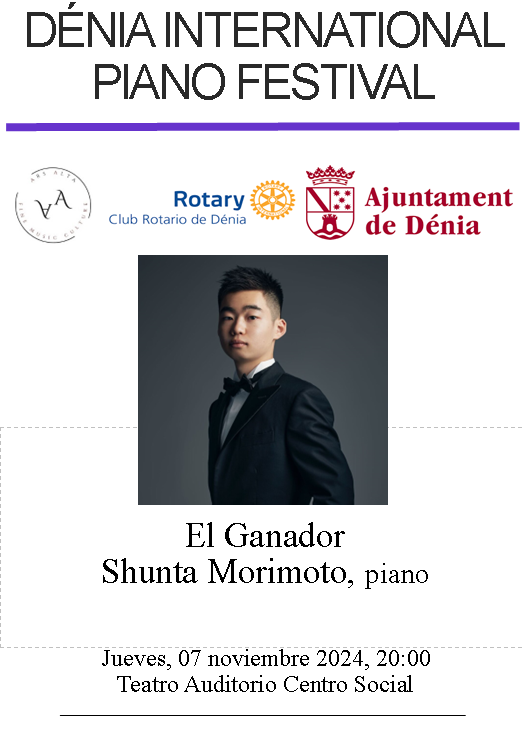
Shunta Morimoto at the Denia International Piano Festival in Bach, Chopin and Liszt


I dont normally write detailed reviews of chamber music concerts. Its not because they often aren’t memorable, its just that I tend to go to so many of them, its often hard to keep up with the writing! This lack of motivation to put pen paper is especially marked when the repertoire on offer is very much standard, comprising often performed works that frankly I have heard many times. It’s not that familiarity breeds contempt. It’s just that what does one say about another fairly standard performance of a standard work, albeit that both the work and the performance are superb? Nearly all the performances I have heard over the years are wholly competent, with one or two exceptions, but it becomes hard to say anything new about them. So what is it about a concert that featured J. S. Bach’s French Suite No. 6 BWV 817, Chopin’s Opus 28 Preludes and Liszt’s Dante Sonata that has provoked me to write? Answer: the performer and the performance. Both were outstanding.

Shunta Morimoto is a young Japanese pianist. He was 19 when he won the Concurso de Piano Gonzalo Soriano in Alicante in April 2024. The competition is organized by Ars Alta Cultural in conjunction with Conservatorio Profesional de Música, Guitarrista José Tomás and this year there were over 100 entrants, with half of them competing in level D, the section for adults, whose age rage was from 18 to 32. Shunta Morimoto, therefore, was at the younger end of the range, and he was the youngest of the finalists. I have been listening to music intently for about 60 years. But I knew from the moment Shunta Morimoto depressed a key in that room in April that he would win the competition and, furthermore, that I was about to witness something wholly special. Put simply, Shunta Morimoto is a genius.

Part of the prize for winning the Gonzalo Soriano competition was to appear in the Ars Alta Cultural concert series in Denia at the end of 2024 and that concert, part of the Denia International Piano Festival, was last night. Shunta Morimoto offered the program mentioned above and, for perhaps the first time in thousands of concerts and recitals that I have attended, I can report that not one of the 110 or so people in the audience made a single sound, apart from applause, of course, throughout the one and a half hours of music. There was no interval, but amongst the audience, silence ruled, so utterly wrapt was everyone in what they heard.

It is hard to describe in words what is so compelling about this young mans playing. The moment you hear the music, it is obvious, but written words have to be read, not heard. Many pianists use bravura, strength and volume to impress. Many play as fast as possible. Shunta Morimoto can offer bravura, the spectacular and the speedy. But above all what he can do is communicate via the music and it is this speaking, apparently directly to an audience without the need of words that is utterly captivating, even arresting.

Every phrase of every piece he played last night was shaped, thought through to make musical sense. At times, he played so softly the music was barely audible, but every note was there, every gesture was clear, every phrase fit perfectly with the musical argument he presented. Even the silences he interspersed for effect were listened to intently by a thoroughly captivated audience.

Chopin’s Opus 28 Preludes, perhaps, was never intended to be played as a single work. But in the right hands, even a composer’s lack of vision can be straightened. I am reminded of a performance about 30 years ago when Murray McLachlan played all the Etudes of Chopin end to end, Opus 25 followed by Opus 10. He was clear that it would not the other way round. I have never forgotten that performance on a baby grand Kawai in a Brunei Hotel. Last night, Shunta Morimoto knew that the Opus 28 Preludes could be played as a single work, and he was right. He succeeded completely.

The Liszt that followed, of course, was breathtaking. In any hands, this Dante Sonata is a real monster, requiring all the skills that a pianist can possibly muster to bring it off. Not only did Shunta Morimoto succeed, but he appeared to bring a new dimension to the work by shaping the quieter sections so finely and so eloquently. Earlier in the day, I had listened to two other performances, by Paul Lewis and Alfred Brendel, so the work was already in my head. Shunta Morimoto’s rendition made me feel like I was hearing it for the first time, so surprising did I find his nuances of interpretation. It was totally recognisable, but totally new at the same time. What a performance!

After a wholly spontaneous standing ovation, he offered the Chopin Barcarole as a substantial encore. Shunta Morimoto, for sure, is a unique talent. He surely has a stellar career ahead of him, and richly deserved. Special.

Monday, October 28, 2024

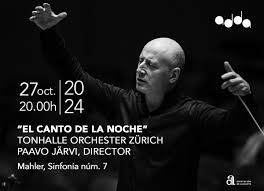
Mahler Seven by the Tonhalle Zurich under Paavo Jarvi in ADDA Alicante


A concert program that devotes 77 minutes to a single work is not commonly encountered. Yes, there are the symphonies of Mahler and Bruckner and Shostakovich, but what else would commonly occupy such a length of time? It was with some excitement that this big event was anticipated.

The bill was, without question, up to the challenge. Zurich’s Tonhalle Orchestra is certainly one of the world’s leading orchestras, and Paavo Järvi’s name could not be bigger in the world of conducting. This particular Mahler Symphony, number seven, is one that I last heard in live performance in a concert over fifty years ago on London’s South Bank. So even the torrential rain in Alicante that surrounded this evening could not damp the enthusiastic anticipation.

Well, did the evening live up to the expectation? Of course it did. The performance was faultless, even brilliant at times, even if it could be argued the Paavo Järvi’s tempo in the faster sections of the first movement could have been a little faster. The overall impression, however, was that the contrasted were stark but never grotesque. This is truly sophisticated music that almost constantly surprises the listener, and it must be expertly played to make sense. The Tonhalle Orchestra took every challenge in its substantial stride and in this variation-like movement, one could not even hear the joins.

Mahler 7 is a groundbreaking symphony in many ways, not least in its structure. A first movement that is alternatively fast and then reflective lasts for 22 minutes. Its loose variation form revisits the same material, but Mahler’s imagination keeps the sound fresh throughout, never in the slightest repetitive. The central section of the movement, that momentary vision of marital bliss, does eventually disintegrate to chaos.

The finale is Mahler perhaps at his most optimistic. The movement seems to dance several waltzes along the way, but overall the feeling is that everyone is having a good time, even though the dance may seem to have a strange shape here and there.

The central scherzo is a very strange experience. Mahler more often than not uses the scherzo to be loud, abrasive, even cynical. But in the seventh, it seems more like a bad dream half-remembered. In between two movements, entitled Night Music, it sounds as if the composer was trying to get to sleep, then nodded off for a short time and dreamt, and then woke up before dawn to lie awake again. The night music movements are perhaps stranger than the scherzo, given their placement after a grand opening and before a triumph for conclusion. Overall, Mahler’s seventh seems like an inverted arch, with a keystone sticking up annoyingly in the middle to stop listeners from sliding down or up.

On a thoroughly successful evening, when the concert received rapturous applause from its audience, I find the need again to praise the ADDA audience for being such wonderful listeners. It’s as if this audience actually absorbs the music.