Showing posts with label rachmaninov. Show all posts

Saturday, June 13, 2026

When superlatives are not enough – Josep Vicent and Anna Federova with ADDA Simfónica in Rachmaninov and Mahler


Last night the 2025-2026 season of ADDA concerts was brought to close. On paper, for a seasoned concert goer, there was nothing particularly outstanding on the program. We were to hear Rachmaninov’s Paganini Rhapsody, and then the First Symphony of Mahler. In the end, the performances of both works approached perfection and originality. Despite the fact that both works were very familiar, the performances achieved memorable status, in the Rachmaninov because of the level of communication between the soloist and the orchestra, and then the Mahler because of the highly original approach to the work taken by Josep Vicent, conductor and artistic director of ADDA Simfónica.

Anna Federova was soloist in the Rachmaninov Rhapsody on a Theme of Paganini. The ADDA audience had a preview of the music during the previous concert when Andrey Baronov played the Caprice number 24 as an encore. Rachmaninov’s variations on the same theme are an orchestral showpiece. There is rhythm and colour in every phrase, but despite all the massive contributions from the orchestra, the composer manages never to impinge on the soloist’s audibility. This is not surprising, since Sergei Rachmaninov was writing the piece to show off his own skills as a pianist, but the handling of the orchestra is also literally brilliant. Everything seems to shine, but the Rachmaninov bells are still in evidence.

The work contains the eighteenth variation, of course, which is become without doubt one of the most popular pieces in the repertoire. It is how it is hard not to sound clichéd in this music, but, as ever, the pace of the performance without pauses between the variations keep the work alive. Context is all – and breaking that context is a recipe for disaster. But ADDA Simfónica under Joseph Vicent brought the whole work to life, not just the famous bit! Anna Fedorova's playing was superb throughout, as would be expected from a soloist who has become so famous for her interpretation of Rachmaninov.

The eighteenth variation also provided the first encore. This was followed by a solo piece by Rachmaninoff, the Prelude Opus 32 number 12 I think. The music did not surprise because it is well known, but the musicianship of all concerned approached perfection.

And then to the second half featuring Mahler’s Symphony No1. I point out that this is the sixth time I have heard the work in concert performance in the last decade. I have probably heard it broadcast many times as well. It was, however, the first time that ADDA Simfónica have played it in a concert that I also attended. I was therefore prepared to renew an acquaintance with a work that I know well and that I first heard about sixty years ago in a recording by Bruno Walter.

Put simply, I have never heard Mahler’s First Symphony played like this. Josep Vicent’s take on the music – because it was surely a personal re-examination of the score that led to this performance – stressed the impressionistic nature of the first movement. The composer himself stated that it is supposed to be infused with nature. It is supposed to be evocative of sounds that one might hear on a country walk. Josep Vicent used rubato throughout the first movement, whenever it would make a point of stressing the detail of every sound combination that Mahler wrote. The off-stage trumpets of the start were miles distant, but the variable rhythm allowed the conductor to bring to the fore every detail of the score. Also clear was how easy is the transition in the slow movement from funeral march to Jewish klezmer. And again the use of tempo change stressed the contrast.

The result was just like hearing the music for the first time, so differently did the performance bring out the contrasts in this music. The approach was wholly original, ADDA Simfónica clearly enjoyed the challenge, it was a clear triumph for Josep Vicent and superlatives were not enough to describe the effect.

Saturday, September 24, 2022

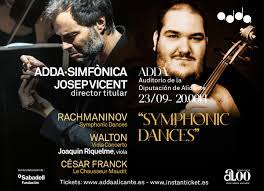
Franck, Walton and Rachmaninov to open ADDA's new season


 The first concert of a new season prompts an air of expectation. A cursory glance of the program suggested nothing particularly special, excepting, of course, the anticipated and always delivered excellence of this orchestra, conductor and auditorium. Billed were a nineteenth century tone poem by an often-overlooked genius, a viola concerto, perhaps the best known in the repertoire and an ultra-late Romantic symphony in all but name, all pieces where familiarity, at least of style, suggested few surprises. How wrong can a concert goer be?

Cesar Franck’s Le Chasseur Maudit is, put simply, a painting in sound. Or perhaps it is film music without the film. It’s a tone poem, that abstract form that the nineteenth century invented to allow a composer to display aural emotional interpretation to project onto the scenes of a story. The very idea of the tone poem is Romanticism enshrined. Cesar Francks pictures are painted with broad, free brushstrokes, but in heavy paint which texture is the surface. The thick orchestration adds drama to the musical story, which was always vivid and clear, if a tad literal.

William Walton’s Viola Concerto followed with Joaquin Riquelme as soloist. Here the textures were light, the musical language suggestive of emotion, rather than the painting of pictures. In a beautifully reflective first movement, the soloist apparently is reading from a personal diary while the orchestra, here and there, adds its comment. The compositional skill is so great that this really is a conversation between soloist and orchestra, their contributions equal, their weights different.

There’s a real burlesque of a scherzo to follow and then perhaps an over-long finale that sometimes reaches for the grandiose, but memories of the first movement’s vulnerabilities always keep the music’s feet on the ground, while its upturned face searches for clouds.

Joaquin Riquelme’s playing was both virtuosic and quietly spectacular throughout. His sympathetic and informed interpretation of the substance of the piece was matched perfectly by Josep Vicent and the ADDA orchestra. At times, it seemed that the soloist was engaged in conversation with the orchestra, but it remained a conversation that was completely intelligible and never dominated by either party. The viola’s understated presence is very easily drowned by orchestral intrusions that are too loud and, apart from a couple of woodwind passages in the first movement, this trap was consistently and skilfully avoided. The audience reception was beyond rapturous. Joaquin Riquelme offered a contrasting encore, being an allemande from a Bach suite.

And then we met Sergei Rachmaninov, but the Rachmaninov from late in his life, at a time when he no longer needed to write music the merely pleased an audience. Not that he ever did! But his Symphonic Dances stand out from the rest of his orchestral writing in that they are more abstract, less prone to indulge in sugary sweetness.

On this occasion, the piece came across as autobiographical. Perhaps the intense rhythmic sound of the opening pages is a reference to the first symphony? This would explain why the rhythm disappears from view. There were passages that were reminiscent of the second piano concerto. There were others those seemed lifted from the second symphony. And, with such a big and varied orchestra, why did the composer include a solo piano part? Certainly, it was not to fill out the harmonies. Surely this is self-referential? And there was another section where the piccolo featured above percussion. Surely this was a memory of Petrushka? And what superb orchestral playing this was, coupled with precise and insightful interpretation that imbued every section of the peace with sense and meaning.

There were two encores, one unexpected, one almost the Adda signature tune. The slow movement from Dvorak’s New World is an unusual encore. but it did provide a superb contrast to the big sound that had preceded it. The Danzon number two by Marquez is now so familiar to the Adda audience that it is almost included de rigueur. But superbly so. Two lollipops of quite different flavours.

But without doubt, the Walton Viola Concerto and Joaquin Riquelme’s stunning performance will live long in this concert-goer’s memory.  

Sunday, October 4, 2009

Costa Blanca Arts Update - Pianist Daniel del Pino plays in La Nucia

A few days ago I wrote a piece about a Russian pianist who successfully mixed so-called ‘classical’ music with jazz on the same programme. In her case, it was one half of each, half great Romantics and half jazz standards plus her own compositions. I could not have predicted that soon I would be reviewing a work by a Russian composer who does much the same thing, but at the same time! 

Daniel del Pino is a fine, even great pianist, known throughout Spain and in concert halls across the world. I have heard recitals by him at least once a year for the last six years or so. Certainly one thing he always delivers is hard work, his own, that is, because his performances are nothing less than a complete delight from beginning to end. 

But there’s no opening Haydn Sonata followed by Mozartian gentility for Daniel del Pino. His programmes are never less than demanding and his most recent recital in La Nucia’s Auditori de la Mediterrània, organised by Los Amigos de la Musica de la Marina Baixa, was no exception. On reading the list of works in prospect on this occasion, however, something immediately stood out. There was a composer I had never heard of – and that’s quite a rare occurrence these days! Daniel began with a finger loosener. In his case this meant six of Rachmaninov’s Opus 39 Etudes Tableaux! If he had played nothing else all night, I would have gone home in bliss. Opus 39 number 5 in E flat minor is a personal favourite and in Daniel del Pino’s hands the exquisite shape of the music, a complex interaction between three musical arguments, was close to sublime. In all, Opus 39 numbers 1, 2, 3, 5, 6 and 9 might, for many pianists, have formed a grand finale. For Daniel del Pino, they were openers. 

He followed this with two pieces by Granados, both Goyescas, El Pelele and Quejas, o Maja y el Ruiseñor. In many ways I find the idioms of Rachmaninov and Granados similar, in that they were both late Romantics, celebrants of the luscious, the personal, the individual and the national. In Rachmaninov’s case, it’s usually the pathos that dominates. In Granados, it’s the sunshine, dance and display, but mingled with some absurdity. Daniel del Pino was able to switch his interpretive landscape effortlessly to bring out the more impressionistic subtleties of Granados. This is music for which he clearly has more than mere feeling. 

His final piece was a rousing finale in the form of Liszt’s Spanish Rhapsody. Alongside memories of the Granados, this was musical tourism, but cultural tourism at worst! Showpiece it may be, but it is harmonically and structurally inventive, so it is musically satisfying as well as being a pyrotechnic display. As an encore he chose a simple – not so simple! – study by Mendelssohn. I have, of course, missed something out! 

Between the Granados and the Liszt, Daniel del Pino presented the eight Concert Studies Opus 40 of Nikolai Kapustin. Now I can hear the concert goers of western Europe saying, “Who?” in concert. In over forty years of listening to music, I have never encountered the name … I think … I have vague recollections of a piece for Jazz Big Band being played on the BBC Third Programme’s Music In Our Time in the mid-1960s. I missed the name of the composer, but now I think I know it. Daniel del Pino introduced the music to his audience before playing it. He told us that Kapustin was Russian, born in 1937, and composed in a pianistic tradition he inherited from Rachmaninov, but placed his thematic and rhythmic material firmly in the idiom of jazz. I have expressed my opinion of ‘crossover’ music before. Usually the result is puerile from the point of view of expression and often mundane in terms excitement and performance. Via the scored and highly pianistic music of Kapustin, we heard something that was definitely not crossover. The music was precisely scored and perhaps there was an arpeggio too far here and there. But while it was clearly rooted in the harmonic language of Rachmaninov and even Scriabin, the material and its treatment were pure bee-bop. Though it may have lacked an improvisatory edge – it seems that Kapustin himself does not claim that he scores improvisations – the music still had the feeling of jazz, but was presented in a structure that revealed itself and engaged. These eight pieces proved to be a major work and technically at least were perhaps the most demanding part of a thoroughly demanding programme. Daniel del Pino’s recital was the work of a complete artist. He can surprise as well as deliver amazing technique alongside superb interpretation and musical sensibility. Hear him play. You will not be disappointed.