How does one
review a work in which one section is so well-known that it is perhaps better
known as an aftershave advert on television than is a piece of music? How might
one describe again an experience that has already been played through on
multiple occasions? Here is the problem for this reviewer of last night’s
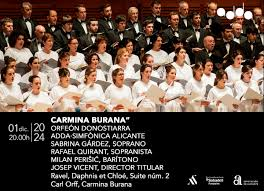
concert in Aliante, in which the ADDA orchestra under Josep Vicent alongside Orfeón Donostiarra
presented two utterly familiar masterpieces of twentieth century music. Let’s start with the aftershave
Given the opening
paragraph, “old spice” is perhaps a good label from which to start. Carl Orff’s
Carmina Burana is perhaps an example of old spice. Since it’s
rapturous reception in Nazi Germany in 1937, it has continued to spice up
concert programs in more ways than one. The composer chose to set these
medieval poems, not only because they were interesting in themselves, but also
because they were rather iconoclastic. Although written by clerics and monks
several hundred years ago, they are at least tongue-in-cheek, anti-clerical,
and anti-church. They are also bawdy and celebrate sex and drinking.
Rabelaisian might be a relevant word.
But they do their
iconoclastic work in the conventional format of a cantata with soloists, though
only three of these, not four. One of them, usually sung by a tenor, has the
utterly thankless task of playing a roasting swan with a skewer inserted in
such a way that it changes the voice to falsetto. Though food seems to be the
preoccupation, one is reminded of the medieval church’s propensity for making
bonfires. The part was convincing sung by Rafael Quirant, who is a countertenor,
who inspired genuine pathos amid the implied mirth.
Milan Perišić’s
baritone was superb throughout. This is the meat of the soloists’ contribution,
and his approach was genuinely and convincingly operatic. He generated superb
dynamic contrasts at times and was thoroughly in control throughout. The
soprano sung by Sabrina Gárdez, had two major contributions towards the end,
and during the second, the voice has to live alone amongst those assembled vast
forces. It has to modally meander its way through a solo without accompaniment,
and then meander back again to finish in the right place. Many do not succeed,
but Sabrina Gárdez did. During this sequence, one reflects how rarely in this
work anyone sings anything without unison accompaniment.
And, speaking of
singing, Orfeón Donostiarra visiting Aliante again did a wonderful job on the
text. Their collective subtlety of expression brought out what was in the work
to express. Much of this choral writing seems to have the character of plain
chant with rhythm, so often there simply isn’t the opportunity to show off
harmonic complexity. Rhythmically, it’s a very
different story and our choir was perfect.
So what does one
do musically with it? The quiet sections have to be quiet and lyrical, while
the fireworks need to be loud, spectacular and perhaps augmented by both speed
and volume. Josep Vicent chose to mix in both at the end of tutti phrases and
everything worked beautifully.
The other part of
the evening was devoted to another resident of the concert hall repertoire, the
second suite of Daphne and Chloe by Ravel. There is nothing literal about this
music. Everything is mere suggestion, an expression of whatever internal
reality or myth Maurice Ravel was wont to experience. As ever with Ravel, it is
hard to pin this music down. It has to be experienced live and its effect,
though lasting, even permanent, does not prompt the retention of earworms. A
wordless chorus does much more than add emphasis and volume to the beginning
and end. In the dawn sequence, especially, they add harmonic texture and colour.
What is utterly
fascinating to see how the composer’s mind worked. In the opening dawn
sequence, the violins are playing a repeated, barely audible arpeggio, which
suggests darting insects, barely visible through the mist. This is music of
truly sophisticated complexity, containing sound that has to be experienced and
cannot be hummed, unlike Carl Orff’s masterpiece, which in comparison, does to
the audience what the skewer does to the swan.