Sometimes a conventional concert program springs surprises when, as an audience member, you least expect it. This evening’s main surprise was the soloist, Claudio Constantini, who is one of the very few “classical” musicians who has made his name across genres on two different instruments, the piano and the bandoneon. Peruvian by birth, but educated in Finland, the Netherlands and France, he has never lost his passion for Latin American music and indeed the popular forms of that music. Having been nominated in 2019 for a Latin Grammy for his playing of Gershwin, it was fitting that in this concert the first half was devoted to the American composer.
We began with the Cuban Overture whose rhythms seemed to infect the whole evening with energy. This is by no means a light introduction to a concert. From the beginning, it is a major piece that might be considered as a tone poem for orchestra. It features Cuban rhythms (it was originally titled Rumba), and Caribbean percussion instruments. Gershwin wanted these at the front of the orchestra, but last night in ADDA a compromise was struck, with percussion at the back of the stage but regularly featuring large, projected onto the back wall of the auditorium. The musical effect of the piece combined with the expert playing of the ADDA Orchestra we sheer delight.
Then we heard Claudio Constantini as soloist in Gershwin’s Rhapsody In Blue. Approaching a work such as this, which in many respects can present a parody of itself, can be problematic. For my personal taste, in the hands of classical musicians, there is often not enough risk taking. In the hands of popular interpreters, the music often comes second behind the performer’s ego. This particular performance, however, was memorable both because the harmonies and rhythms were properly stretched to excitement, but also because the playing was accurate and respected the score. Claudio Constantini’s playing of the solo part illustrated the fact that he has he has he has played it before. His dynamics and timing were exquisite.
Now usually, the ADDA audience demands an encore from a soloist. Often performers appear reluctant to offer one. Not so Claudio Constantini, who needed no repeated curtain calls to come back on the stage with a bandoneon. He played one of his own compositions with string accompaniment, a tango of sorts, a milonga perhaps, where the cadences often sounded like Piazzolla. Superb. Quiet. Very successful.
In part two we heard a performance of Beethoven’s Pastoral Symphony, No. 6. But this was different from any other performance of Beethoven 6 that I personally have heard.
ADDA programmes often list the movements of a piece alongside their timings. Last night’s programme did list the movements but gave only the duration of the whole symphony. Josep Vicent clearly decided that this performance of the work would have no pauses at the movement breaks and so we heard forty minutes of music without a break. It worked beautifully and Beethoven’s vision of rural life did come across as a vast picture of both landscape and people’s place within it. This playing of the piece without a break was a real surprise, and it was truly memorable.
Gimenez’s The Marriage of Luis Alonso closed the
evening, and Josep Vicent encouraged the audience to accompany by clapping.

These days, one always expects a lot from any performance by members of the ADDA Orchestra and one is never disappointed. This subgroup, called ADDA Cameristica, gave a free concert last night in the Sala Ruperto Chapi featuring the kind of program that a commercial concert would simply not present, because commercial considerations would preclude it. As a consequence, the likelihood that music lovers would ever have a chance of hearing pieces of this kind, especially those included in the first half of this ADDA concert, is minimal. Certainly in over fifty years of concert going, I have never had the privilege of hearing the Strauss Serenade performed as a chamber music piece.
This was a concert of under an hour of music but involved two quite different ensembles. In the first half we heard two pieces of music for a wind band, one of which also had percussion. Jesse Passenier’s Overture for 13 winds and percussion was a world premier performance of a piece that uses jazz idiom alongside formal structures in its ten-minute duration. It is based on two sections that are then repeated with variation. A slow, highly textured section gives way to a rhythmic and staccato dance-like second section, where the percussion adds weight. These two sections are then repeated with variation to complete the work. Writing a piece for thirteen winds and percussion is a very laudable exercise, but one wonders whether the composer would ever have expected to hear it professionally performed. Memorable were the shared textures that the contrabassoon and the bass clarinet created. This was an exciting work that should be played often.
Richard Strauss’s Serenade for thirteen winds is a masterpiece. The programme listed the work as Opus4, but I think it is Opus7. The Suite Opus 4 is considerably longer that the ten-minute piece we heard. The fact remains that Richard Strauss was just seventeen when he wrote it. If it is played at all, it tends to be played at the opening of a symphony concert, in which these gentle sonorities become somewhat lost in the oversized acoustic. It was then a revelation to hear the piece played in a small auditorium designed for chamber music. It is a youthful work, written by teenager for his father. It is a masterpiece, albeit in Richard Strauss’s terms, a miniature. The four horns that are that are demanded by the composer are worked quite hard, but these players of the ADDA Cameristica were faultless.

And what work this is.
It sounds as if it had been written for a string orchestra in the original.
Beethoven’s often surprising use of rhythm
and dynamics really did work extremely well in this larger setting. It was a
memorable performance worthy of repeated hearings. Wonderful.

A few years ago, a concert program comprising two
works by Beethoven, and one by Schuman would not, for me, have aroused much
interest. That is the value of an abono, a subscription, because a subscription
means that you have opted for an entire season of performances and thus one
goes to whatever is on offer. My wife and I have had a subscription to Alicante’s
ADDA auditorium for several years and so we are now used to attending concerts
that would not usually be in our comfort zone, which is that of twentieth and twenty-first
century music. Last night in ADDA, we received a clear statement of what we have
been missing over the years when we repeatedly tried to edit out what we didn’t “like”.
The concert was by the London Philharmonic Orchestra
under Vladimir Jurowski and featured the violin playing of Vilde Frang. Right,
that has got the star billing out of the way! The concert presented Beethoven’s Coriolan Overture, Robert Schumann’s Violin Concerto,
and then Beethoven’s Symphony No. 5. For
someone who does not normally warm to Beethoven’s
symphonies, I confess that in concert over the last two months I have heard
numbers four, five and seven, and all three in their own way, have proved to be
the highlights of a very rich musical year. My fear of cliché often gets in the
way, but these three performances, and last night’s number five included, have
all been outstanding.
Vladimir Jurowski needs no introduction. He is a
justifiably a world-famous conductor. He is very economical, highly proficient
and a very precise conductor. There are no grand or grandiose gestures, just
content. The way he communicated what he wanted to stress in this performance
of Beethoven’s Fifth Symphony was both subtle and dramatically perfect. His
indication of the syncopations in the final movement, for instance, were both
precise and perfectly judged. In the central movements, Beethoven’s
memory of wind bands in the street were clear, but the context was always
architectural, with nothing being played for momentary effect. The pace of the
first movement was fast and this “knock of fate on the door” was truly
frightening. Again, I am tempted to describe the playing and the conducting as
perfect.
The Coriolan Overture in its own way a masterpiece.
Here Beethoven is trying to give us a complete Shakespeare play in five
minutes. The ending, where treason results in public disgrace, is telling.
The Violin Concerto of Robert Schumann is potentially
at least a problematic work. It is a late work, perhaps conceived when Robert
Schumann was not fully in control of his own mind. But how many of us care when
the result is what we heard? Vilde Frang’s playing
made sense of this rather rambling score and the orchestral accompaniment was
always sympathetic to her substantial dynamic. The sound from her Guarneri was
something to behold. She did play an encore, which I believe was Montanari’s Giga
Senza Basso.
I intend to repeat the subscription for another year at least!

Last night’s performance by the ADDA orchestra under Josep Vicent featured the cantata that Prokofiev constructed out of his incidental music to Eisenstein’s film This choral work has since become a concert hall regular, perhaps the major cantata of all twentieth century music. Performances are not offered very often, however, because it is a work that needs a lot of resources, large numbers of human beings and, if it is to be done well, lots of rehearsal time.
This performance, subtitled “La Leyenda del Príncipe y el Lago Helado”, of the purely musical work was accompanied by a brief passages from the film, projected above the heads of the Orfeón Donostiarra chorus. There was enough visual material to provide context, but no more. In any case, Prokofiev’s cantata score does not follow the film’s action sequentially, only thematically. Rest assured that this is a massive work and, for many concert goers, it is probably a one-in-a-lifetime experience. Not only does it demand a large orchestra and a full chorus, it also has a soloist, mezzo-soprano Silvia Tro this evening, to sing an orchestral song towards the end. Silvia Tro’s performance of this patriotic text was moving, though its propaganda message was better left untranslated.
From the start, indeed, we can hear that this is a Prokofiev score because of the filled out and emphasised bass. The orchestration is simply spectacular and the ADDA orchestra delivered perfectly all the unexpected and frankly surprising textures. Even the opening chords, delivered softly offer the listeners something of a surprise.
Josep Vicent had placed the percussion not at the back, because Orfeón Donostiarra were there. Hence the players of extensive percussion section were immediately behind the violins. This brought all the percussive colour to the fore, and the effect was spectacular. At the start of the battle on the ice scene, it seemed as if the assembled army on stage had come alive as a single insect-like force, scratching its way towards the audience. Simply spectacular.
Truly spectacular had been the first half of the concert. Beethoven’s Seventh Symphony is clearly a favourite of Josep Vicent and the ADDA orchestra. I have heard them perform it at least three times and, if it were on offer again today, I would be first in line for a ticket. I will limit my description of the piece, because it has featured regularly in ADDA concerts.
This was playing of the very highest quality. Not only
was it accurate and controlled, but it also came across a slightly reckless,
even improvised. But of course, it was not, but this performance had the
quality of experiment at breakneck speed. The performance of Alexander Nevsky
was both welcome and spectacular. But it was Ludwig van Beethoven who stole
this music show.
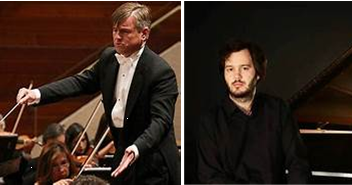
The first surprise, though it was announced in advance, was the identity of the soloist. Antonii Baryshvskyi played the concerto instead of Judith Jauregui, who stepped down on medical advice. In addition, the evening’s conductor was Joachim Gustafsson, a guest of the ADDA Simfonica, was making, I believe, his first appearance with the orchestra.
The fourth piano concerto of Beethoven is a masterpiece. It has that amazing concept of a slow movement where the quiet piano competes with angry strings and wins them over by gentle persuasion. It is perhaps one of the most original pieces of music ever written. In the hands of Antonii Baryshvskyi, the movement attained perfection.
But so did the first and third movements. Antonii Baryshvskyi’s style throughout was sensitive and accommodating of an orchestral sound that refused to dominate. This was real human dialogue between soloist and orchestra. In fact, the orchestral textures throughout - except, of course, for the strings in the second movement - were light and played softer and with less attack than would be the norm. The overall effect was to render the whole work profoundly human and humble. Then, given the nature of the argument of its second movement, this approach rendered the experience utterly moving from the first note to the last. Surely everyone present was deeply affected by this perfect music making.
Antonii Baryshvskyi chose to play different credenzas from any that I have previously heard. This concerto has several cadenzas written by various composers and pianists. I did not recognize the ones that the pianist chose, and conclude, therefore, that they were his own. It was both surprising and startling to have contemporary-sounding cadenzas appearing in such familiar music, but nothing was out of place. Everything made perfect musical sense. Joachim Gustavson’s muted approach to the music allowed the experience to develop and the space thus created was emotionally very special. Antonii Baryshvskyi then played two encores. The first was Chopin’s Revolutionary Study – how apt, given what we had just heard! - and the second, again I speculate, was probably his own work. The ADDA audience gave him the warmest possible applause in recognition of something profoundly special.
So after the familiar cast anew in the first half, the second half embarked upon the less familiar fourth symphony. The fourth symphony’s opening could pass for Mahler and the rest is hardly less revolutionary for the first decade of the nineteenth century.
Beethoven wrote the work after the Eroica and before the anger of the fifth. It is a work that could be superficially classed as a tranquil interlude between two great statements. But anyone who listens to this music will conclude that it is wholly original and indeed visionary. There were times when we might have been listening to Mendelssohn, forty years early!
Again, Joachim Gustavsson’s reading of the music was perfect. The music seemed actually to be human, so much did it seem to breathe. Anyone unfamiliar with this work, and there will be many, even amongst regular concertgoers, should listen intently to its argument because it makes perfect sense. The rhythmic variations Beethoven used in the scherzo are reminiscent even of the seventh symphony. This was a performance that will live in the memory forever.
The evening’s third
encore was something completely different, the Intermezzo from Mascagni’s Cavalleria
Rusticana. Like everything else on this wonderful evening this was a surprise.

The program was all Beethoven. And Beethoven from that
period of his creative life when he was actively pushing the boundaries of
classical form to the limit in the establishment of musical Romanticism.
The second half was devoted to a performance of the Eroica
Symphony. It is difficult to say anything new about work that is a pillar of
European culture, a work that is so often performed and recorded. But what was
really memorably original about this performance was its audience. It wasn’t
that the orchestra played badly and that our collective interest wandered. Far
from it! The concentration of this ADDA audience was almost audible at times,
or inaudible, if you see what I mean. The quiet passages were listened to with
such concentration and silence that every nuance of even the quietest music shone
clearly through.
Beethoven’s design
thus became completely visible. Obviously, this symphony was written to pay
homage to Napoleon, but then the replacement of a triumphal march for a funeral
march rendered the piece heroic, rather than laudatory. And what more, in this
performance, specifically as a result of its audience’s concentration, the
music allowed Beethoven’s purely
personal statements to be experienced clearly and intimately. It is often said
that the Eroica’s finale was Beethoven’s defiant
gesture to his worsening deafness, but in this performance, the suggestions of
doubt and insecurity were clearly in evidence. The result was a truly rounded
and complete experience, full of vulnerability and self-doubt, as well as
energy and heroism. How many pieces with a complete funeral march movement were
ever branded triumphal? I simply don’t know.
Here, and as much because of the audience’s concentration, we saw the full
picture. An encore came from a movement from Prokofiev’s Classical Symphony, and
it sent everyone home lighter.
The first half and been a complete gem. Beethoven’s Triple
Concerto is often problematic in performance. The solo parts are probably not
big enough to warrant booking three top-rated soloists. On the other hand, if
the playing is less than perfect, or of the featured ensemble does not gel, the
sense of a shared chamber music experience, which surely the composer intended
but on a larger scale, would be lacking.
In this performance, the ADDA orchestra was fronted by
a trio that regularly plays chamber music together, Trio Vibrart, Miguel Colom
on violin, Fernando Arias on cello and Juan Pérez Floristán on piano. Individually,
they were more than capable of playing concerto-like roles, but they also
brought the cohesion of a chamber group to the music. This had the effect of
thoroughly integrating the ideas, thoroughly integrating the chamber music of
the soloist group with the chamber music-like orchestral interventions and accompaniment.
The performance was not only a success: it transcended the concept of success.
As an encore, the Trio Vibrart offered an arrangement
of one of Ginastera’s Argentinian Dances. The contrast that this folk-inspired,
ever-so-slightly modernistic music presented brought the whole memorable
evening together. Bravi to all concerned, especially the audience!

Let’s start
with Beethoven’s Third Piano
Concerto as interpreted by Francesco Piemontesi. As the program notes
underlined, this work was Beethoven’s big
break with the past, at least, as far as his concerto writing was concerned.
This work was not to follow the eighteenth-century model of elegance before
challenge. This third piano concerto of Beethoven has a really symphonic feel.
The dialogue between the soloist and orchestra, contrasts strongly, here
argumentative, here supportive.
And Francesco Piemontesi’s playing, brought out all
the subtleties, without once resorting to gimmick or bravura. What was obvious
from the opening orchestral passage to the work’s end was a sense of
cooperation between the soloist and orchestra, a sense of communication and
sharing, despite, on occasions, the music demanding, strong contrast. Francesco
Piemontesi gave a brilliant performance, topped by a significant encore
The orchestra was the Dresden Philharmonic, under the
baton of Pablo González.
Unusually Pablo González
opened the second half with a short verbal presentation about Richard Strauss’s
Ein Heldenleben. The work is clearly something special in the eyes of Pablo González. He described it as
at least one of the greatest of all musical creations. And he stressed that
this was not the Richard Strauss Don Quixote, although he went on to describe
the piece as surreal and satirical, both of which might apply to the way a
modern mind appreciates Cervantes’s novel.
And the performance was indeed something special. This
is a piece that orchestras often play as if it were a gymnastics exercise. But
here the romanticism and lyricism were stressed, and the music flowed rather
than exploded. Here we had pauses to emphasize transitions, changes in dynamics
that brought out all the textures in this multi-layered work. And we really did
hear all the complexity of the aural colours that this great work projects.
As an encore, Luis Alonso got married again. This
quintessence of popular Spanish music brought the house down.

Beethoven’s Ninth Symphony is one of those works I can hear anytime I want. I play it to myself in my head - at least, I think I do. It's a work I and many others have heard so many times, I sometimes wonder what might be gained from hearing it again. On this occasion, I need not have worried.
This is always a concertgoer’s dilemma, at least, if you are a concertgoer like me, who always craves new and original experience. There are many concertgoers, perhaps even a majority, who want only to hear what they know, hence the rather repetitive and perhaps, at least to me, the rather stultified and predictable nature of a lot of programmes.
As a season-ticket holder, however, one does tend to go to whatever is billed, and on Sunday, 10 December 2023, Josep Vicent and the ADDA orchestra chose to play Beethoven Nine.
I tried to remember the last performance of the work I attended. It must have been that Promenade Concert over twenty years ago that I attended with an old college friend, when an original instrument group performed it. “It’s being sung on the original voices,” said my friend with more than a smile. We were a long way from the stage in London’s Albert Hall. The work, of course, filled the space. More often than not an overlooked but regularly visited friend is full of surprises when we do finally make contact.
And it was true with this performance of Beethoven Nine. There were even surprises in Josep Vicent’s reading. The opening bars, for instance, are so often played with the first violins cutting forte through the general tremolo. Here they were subdued, understated. In the last movement, when the famous theme establishes itself on wider strings after cellos and basses have introduced it, Vicent had the woodwind come almost to the fore with its argumentative counterpoint. Thirdly - and what a masterstroke! - the presence of the chorus on the stage meant the timpani had to move. Vicent brought it almost to the front of the stage alongside the violas and cellos. The timpani, of course, plays a thoroughly significant role in the work, and not only in the groundbreaking second movement, where it played melody for perhaps the first time. The four soloists, Erika Grimaldi, Teresa Iervolino, Airam Hernández and José Antonio, were all more than up to their tasks. Positioned just ahead of the chorus, they sang with remarkable clarity, volume and commitment.
But the real star of the show was the chorus, Orfeón Donostiarra. The chorus were not just committed to the task, they sang as if their lives depended on it. But they were always totally musical, never prone to stress volume rather than tone, always accurate, with every dynamic change respected. The amazing quality of their work was recognized by the audience’s loud cheers at the end, a gesture that was both noticed and appreciated by everyone present.
In the first half we had Montsalvatge’s Cant
Espiritual de Joan Maragall, a twenty minute work for chorus and orchestra. Maragall’s
words concentrate on the prospect of life after death, in contrast to Schiller’s
which, as we know, are really interested in the here and now. Montsalvatge’s
music, understated neoclassicism, mixed with modernism and popular song, came
across as the perfect foil to the grandiloquence that was to follow. But in
Beethoven’s case, the grandiloquence works
every time. It’s grandiloquence with consequences and there’s
not an empty second in the experience. In our current world, we need more, not
less calls for brotherhood and sisterhood amongst all people.

The Sinfonia Varsovia’s advertised conductor, Tatsuya Shomono, had to cancel his leadership of this concert, which had originally planned a performance of Bruckner’s Fourth Symphony, after the first half when Pinchas Zuckerman would play the Beethoven violin concerto. But the conductor was ill and could not travel. So Pinchas Zuckerman picked up the baton as well. Or, rather, he didn’t, because he didn’t use one!
A change of program saw the Beethoven Concerto moved to the second half, and the new first half presented works by Penderecki and Schubert. The Sinfonia Varsovia string players opened the evening with Penderecki’s Chaconne In Memoriam Pope John Paul II. And they played it without a conductor, with apparently all the delicate communication skills of a chamber ensemble. Delicate also applied to the music, which seemed to examine, and then re-examine feelings of loss. Played thus, seemingly without active direction, save for a gesture, or a bow stroke from the lender, the Penderecki Chaconne began this evening in a thoroughly original way, though quietly, without show, with delicacy.
Pinchas Zuckerman then conducted Schubert’s Symphony No. 5. In this work, a young Schubert takes his compositional lead from Mozart and Haydn. The music exudes control, form, structure and process, rather paroxysms of emotion. And, as such, it worked beautifully, allowing the orchestra again to play like a chamber group with elegance, poise and, yes, delicacy.
After the interval, Pinchas Zukerman, was soloist and director for Beethoven’s Violin Concerto. Now I have often heard the soloist treating this work as if it is a grandiose statement, as if every phrase needs staccato attached. And so this evening’s performance by Pinchas Zuckerman came as a real surprise, almost like a breath of fresh, delicate air. He stressed the shape and phrasing of this music and, crucially, demonstrated how the soloist blends with, interacts with, and times contradicts the orchestral accompaniment.
I first heard Pinchas Zuckeran in London’s South Bank about half a century ago and I don’t remember the concert. But I will remember this location, especially for the refined, and subtle delicacy that he brought to the music and the occasion.
Visibly
tired by the end, he kept returning to the platform since the ADDA audience
never wants to let anyone have an easy time. He did offer an encore, a short
cradle song, to which he invited the audience to “Sing along”. It was a grand,
memorable, delicate gesture.

The orchestra, La Scala, Milan under its conductor Riccardo Chailly, has a tradition with Mahler symphonies, and this is very much the tradition of its conductor. Ricardo Chailly, the program noted, has over 150 recordings to his name and he also has recorded a complete Mahler symphony cycle with the Leipzig Gewandhaus. ADDA’s audience thus expected a lot from the evening. There was no disappointment.
Beethoven’s First Symphony was premiered in 1800. Stylistically, it is rooted in the tradition that Haydn and Mozart had created in the previous century, but from its opening, Beethoven’s first is different. While we now label the earlier era as classical, Beethoven’s first surely heralded the era of Romanticism, where the expression of individual emotions rather than structural integrity was to be the focus of artistic intentions.
The structure is there from the previous classical era. Sonata form is evident in the first movement and elsewhere. The fast, slow, minuet and finale format is preserved, but the principal keys, which still dominate the work, arrive more by suggestion than by statement and the minuet is barely danceable because its character is that of the modern scherzo. The very word implies a musical joke, perhaps a piece of trivia included to express personal feelings and reflections.
This is thus a work that represents a revolution of symphonic thinking, but this revolution was not a break with the past, more its extension and amplification into new territory. And though Beethoven’s orchestra was large for its era, it still comprised only double winds and no trombones or tuba. What characterizes the music, however, as so often in Beethoven, is the possibility that the inspiration came from the composer’s memory of dance tunes and popular music, reworked and remodelled into “serious” form.
And so to the link. At the end of that nineteenth century, Gustav Mahler announced another stylistic revolution with his first symphony, whose most noticeable difference from the Beethoven was immediately the size of the orchestra employed. There are four movements again. But now the movements pay only lip service to the formal structures of sonata form, which, like Beethoven’s introduction of the tonic, is via suggestion rather than statement. The placing of the slow movement third rather than second began with Beethoven, so this was nothing new.
But what Mahler did that was revolutionary was to incorporate folk-like melodies into the symphonic argument and render that argument largely textural. Here, the composer seems to want to explore the range of sonorities that these large forces could generate. But despite the composer’s reputation for deploying large forces, these sonorities are only rarely loud or brash. These contrasts are textural and coloristic, clearly intended to convey to the listener the quality of an experience, rather than its narrative.
A contemporary listener can only imagine what an audience in central Europe made of a slow movement that juxtaposed a funeral march based on a French children’s song with passages that derived from Jewish Klezmer dance music.
Perhaps the finale is a little too meandering and perhaps its triumphal end is overblown. But who cares? And this performance, under the watchful eye of Ricardo Chailly, was wonderfully detailed. Here we heard all the sonorities and all the dynamic changes in intricate and vivid detail. Everything seemed to make sense, even those passages where the composer seemed to delight in the tangential. The use of rubato was obvious, but never overdone. Everything made musical sense to the extent that during the first movement this listener heard the progress as a walk through scenic countryside! It is a work I have heard many times before but with Riccardo Chailly’s vision and supremely masterful reading, I now can’t wait for the next performance.
And what about the comparison, Beethoven to Mahler,
mentioned at the start? Beethoven arguably invented the individual’s experiential
centrality in the symphony. No longer was the form a rigid frame that had to
contain certain elements. In his first symphony, Beethoven had not yet fully
divested himself of the need to conform, but the innovations he introduced were
well developed in Mahler’s time. By the end of that nineteenth century, the
individual’s emotions and feelings had become the point of the exercise, not
mere suggestion and in Mahler’s first, we meet the composer, not the structure.
In fact, the whim of the composer’s intention was about to prompt others,
following the current extension of harmonic complexity, to call again for the
imposition of structure. There was a tradition, but perhaps by the century’s
end, there was nowhere else for the style to go. And, if we were to accept popular
tunes into the symphony, why not make folk culture central to the argument? A
new era dawned.

I have seldom had the privilege of participating in a concert audience that showed their appreciation with such heartfelt enthusiasm. At the end of this performance of Mahler’s First Symphony, the fourth time that this symphony had been performed in this hall in recent years, this particular orchestra, the Dusseldorf Symphoniker, and this unique conductor, Adam Fischer, was cheered loud and long by admirers who stood to pay their respect to the quality of what they had just heard. Again the power of live performance is underlined as yet another life changing experience is perhaps surprisingly provided by a work whose intricacies were already familiar to most of the listeners.
And it must be said that the first half of the evening had already proved to be equally memorable via a performance of an equally familiar piece, the Emperor Concerto of Beethoven. The soloist was to have been Andras Schiff, but he had unfortunately had a fall and could not perform. We must wish him a speedy recovery.
.jpg)
Elisabeth Leonskaja not only achieved the right balance, not only communicated these contrasts perfectly, but she also brought that something extra, that indefinable quality that we can all sense but never describe when we are in the presence of genius. And that genius became even more apparent when she offered her audience a substantial encore, a piece whish explored the impressionistic and symbolist imagery of music a century later than the work she had just performed. The result was spellbinding.
In the second half, it was the work, not the performer that was the replacement. Originally Bartok’s Miraculous Mandarin had been programmed and its replacement brought a certain amount of disappointment to this particular member of the audience. I should not have been concerned, because what transpired over the fifty minutes of the second half was nothing less than miraculous.
Misgivings turned to gold as Adam Fischer’s clearly magical relationship with both the orchestra and the work unfolded. It seemed like the conductor was convinced he could drag extra expression from his players by brute force, persistence and dogged insistence. To describe him as living every note would be understatement, since his relationship with the piece is clearly deeper than that. At one point, there was real concern that he had put too much into his work as he stepped aside to take a short breather. In reality, we all needed that little space. The attention to detail was phenomenal, right down to the balance of the offstage trumpets at the start being controlled by just the right distance to leave the side doors ajar. At the end, Adam Fischer insisted that the final fanfares be delivered by standing horn players and the sound was resplendent. But again, it was in the vision of the overall balance of the symphony that Adam Fischer displayed his complete genius.
The inclusion of a
Brahms Hungarian Dance as an encore certainly did not compensate for the
missing Bartok, but by then we all felt that we had at least visited the
conductor’s cultural home, albeit from afar.

Live music in December 2020 is probably not the commonest of commodities wherever you live. In our corner of south-east Spain, we have some. In normal times, whatever that phrase might now mean, there would be at least the opportunity of attending two or three concerts a week in this area, but our new normal here has for several months changed the situation. Whether it is this new scarcity, this new normal, or indeed whether it is simply the quality of what we hear, I have no idea, but I can record without hesitation that everything now sounds more vivid, more committed and more beautiful. And so it was for the two chamber music events presented by Alfas del Pi’s Classical Music Society this weekend.
On Saturday 12 December in Casa Cultura, the society hosted a piano trio with what looked like at first glance a fairly standard program. The trio comprised the clarinet of Vicenzo Mariozzi, the cello of Francisco Mariozzi and the piano of Andrea Rucli. This was in fact the fourth concert of the trio’s mini tour with the same program and, if the other three venues had provided rehearsal time, then this fourth concert’s perfection might just have another explanation apart from the obvious and sustained virtuosity of the musicians.
We began with the Brahms trio opus114. Its gentle, almost flickering lines assemble to present a mind in turmoil. The phrases may be short, sometimes very short, but the statements are long and sometimes convoluted. But eventually this is direct music, despite its almost constant asides, whose surface a listener can enjoy at an aural glance. But there is much more here only just below the gloss. There is the aftermath of depression, an obvious, but, one feels, an unfulfilled desire to reflect on a past that has some powerful memories. There is nostalgia alongside fear of the future and the unknown. The music seems to reek of regret. Its style and hand are both utterly assured, but the composer is suffering new personal doubt, so we are presented with a contradictory and compelling mix of late Brahms, personal doubt expressed via assured technique, intangible feelings precisely described. It was a picture that Vicenzo Mariozzi, Francisco Mariozzi and Andrea Rucli conveyed via a remarkable skill of understatement.
In retrospect the next two works on the program formed a similar pair, an unexpectedly similar pair in that they seem to share an unusual conceptual framework. Beethoven was a young man when he wrote his opus 11 trio, the Gassenhauer. He wanted to show off. He wanted to make his mark on the city‘s life, future earnings being the goal. He thus wrote a serious trio that showed off his melodic, conceptual and compositional gift. But crucially he adopted a contemporary earworm for the main theme of the finale. It was a tune that everyone was whistling around the town. In Beethoven’s hands, it became a set of variations where the main variable is rhythm. This trivial little idea then becomes something grand, even grandiose at times, despite its humble origins. It was rather what Beethoven himself wanted to do in his own life.
The final piece in this program was the trio by Nino Rota. The work’s first two movements are both highly melodic and very rhythmic, but the musical language is couched in a style that can only be described as astringent neoclassicism. This may not be Hindemith, nor Stravinsky, but it is music with a hard, sometimes spiky surface. The finale, however, is like a scoop of ice cream on a crumbly biscuit, an almost hackneyed ditty that sits somewhere between Charlie Chaplin and the Keystone Cops. It’s a moment that reminds us not to take anything too seriously, except, perhaps, a sideways surreal and thus revealing view of life. Beethoven chose a silly ditty to self-aggrandise, whereas Rota seems to make fun of the whole process until, however, one realizes how beautifully written and constructed is the entire work. And the fact that this commentary deals almost exclusively with the impressions delivered by the pieces is testimony to the perfection that Vicenzo Mariozzi, Francisco Mariozzi and Andrea Rucli brought to the playing.

And then, on Sunday lunchtime Alfas del Pi Music Society presented a violin and guitar duo in Albir. It’s a combination and a concert we have heard before and hopefully we will hear again. The society’s vice-president, virtuoso violinist Joaquín Palomares renewed his performing partnership with guitarist Fernando Espí in a program they titled Música Iboamericana. In theory, these might be viewed as lighter pieces, an assemblage to pass a pleasant hour on a clear and sunny December day by the sea.
But the understanding between these two virtuoso
musicians renders everything they play not only elegant but also exciting and
ultimately moving. The program was the Serenata by Malats, the Brazilian Dances
of Machado, a Milonga by Tavolaro, Amasia by Boutros, three of Manuel de Falla’s
Popular Songs and two movements from The Story of the Tango by Piazzolla. The
music went from bossa nova to tango, from Europe to South America, from folk
music to dancehall, a journey which, when contrasted with the trio of the
previous evening, really did illustrate how far music can transport an audience
and the different places it can take us.